
DSP3000 Servo Press
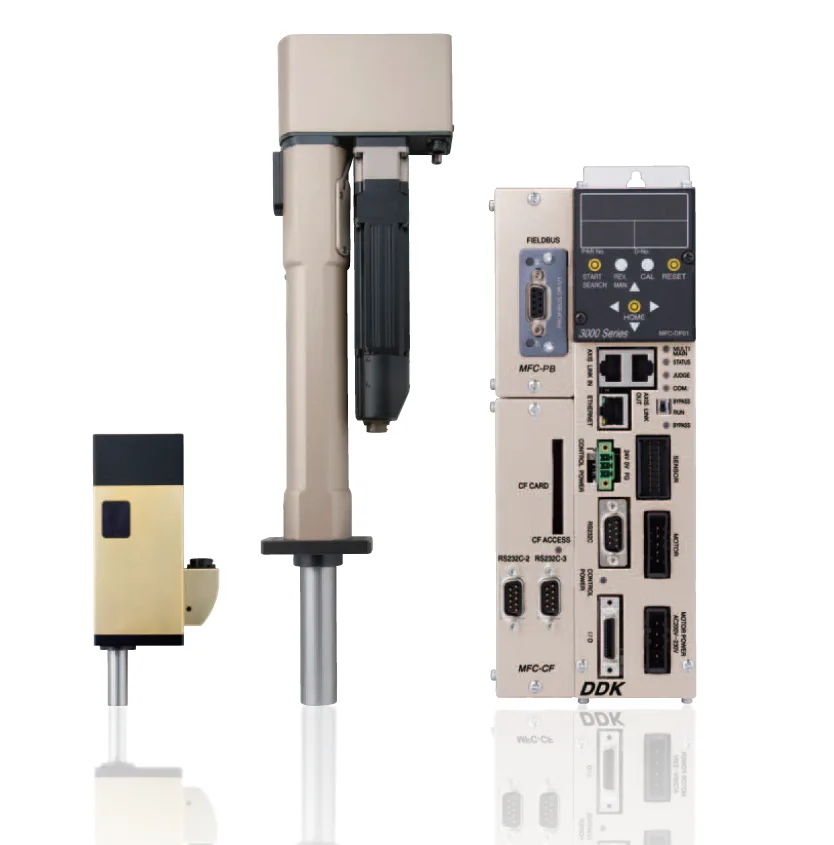
The DDK DSP3000 is a fully digital servo press series from DAI-ICHI DENTSU (also called a press-fit machine or servo electric cylinder). A built-in load cell enables high-precision pressure control with a pressure sampling period of 1 ms or less and repeatability of ±0.01 mm. Up to 128 parameter sets can be stored to manage load, distance and press-fit waveforms. Standard models cover 0.1 t~20 t and come in several types, including the DPS slim, DPM mini and DPT upright, with six press-fit control methods such as the load method, distance method, and load rise / drop point detection, for bearing, pin and bushing press-fitting and riveting.
Manufacturer: DAI-ICHI DENTSU (DDK) | Category: Servo Electric Cylinders | Models: DPS SLIM LINE PRESS, DPM MINI PRESS, DPT PRESS
DAI-ICHI DENTSU (DDK)
DSP3000 High-Precision Servo Press
A built-in load cell enables high-precision pressure control.
32 parameter sets for a single unit and 128 sets for multiple units accommodate a wide range of process conditions.
Dedicated PC software with a graphical interface is used to set parameters and manage press-fit data such as load, distance and press-fit waveforms.
High-speed pressure sampling (within 1 ms) with repeatability of ±0.01mm.
Wide Range of Configurations
- DPS Ultra-Thin Servo Press -> Designed for multi-axis arrangements, making production lines more compact
- DPL Thin Servo Press -> Reduces equipment size for easier machine and floor-space planning
- DPM Mini Servo Press -> A compact, lightweight servo press for loads up to 1kN
- DPT Vertical Servo Press -> The conventional vertical type, with the most complete range of models and load classes, covering 0.2~20 ton
Standard pressure range: 0.1t~20t

Application Cases
Our Customers





Models and Specifications
| Item | DPS SLIM LINE PRESS | DPM MINI PRESS | DPT PRESS |
|---|---|---|---|
| Type features | Ultra-slim, allows multi-axis side-by-side mounting for a more compact line | Compact mini type, reduces equipment size | Conventional upright type, wide range of performance options |
| Max. rated load (kN) | 5~200 (0.51~20.39 ton) | 0.5~1 (0.05~0.1 ton) | 1.96~196.1 (0.2~20.0 ton) |
| Max. continuous load (kN) | 1.8~200 (0.18~20.39 ton) | 0.49 (0.05 ton) | 0.43~196.1 (0.04~20.0 ton) |
| Max. speed (mm/s) | 32~333 | 130 | 16~416 |
| Stroke (mm) | 200 / 300 / 400 | 100 | 150 / 250 |
| Weight (kg) | 16.4~222 | 4.0 | 10~650 |
| Shaft diameter (mm) | 40~120 | 40 | 30~130 |
| Compatible controller | MFC-S060S, MFC-S120S, MFC-GSC | MFC-S024S | MFC-S024S, MFC-S060S, MFC-S120S |
| Load cell | Built-in | ||
| Pressure sampling period | 1 ms or less | ||
| Repeatability (mm) | ±0.01 | ||
| Load control range (kN) | 0.25~200 | ||
| Parameter sets | 32 (single unit) / 128 (multi-unit) | ||
| Max. sequences | 64 | ||
| Max. connected axes | 32 | ||
Highlighted rows differ between models; values shared by all models are merged into one cell.
The table above shows the range covered by the three series; see the selection tables below for the specifications of individual models. Multi-unit parameter sets and the max. number of sequences require an expansion unit.
For full specifications and dimensional drawings, see DSP3000 Servo Press Catalog (PDF).
DPS slim press tool selection table
The flat mechanism is suited to side-by-side multi-axis mounting. Standard models (starting with F) are mainly for press-fitting, with a max. continuous load lower than the max. rated load. High-output models (starting with P) are for processes such as pressure bonding that require sustained pressing over long periods, with a max. continuous load equal to the max. rated load.
| Model | Type | Max. rated load kN (ton) | Max. continuous load kN (ton) | Max. speed (mm/s) | Stroke (mm) | Weight (kg) | Overall length (mm) | Shaft diameter (mm) | Compatible controller |
|---|---|---|---|---|---|---|---|---|---|
| DPS-051R3-20FB | Standard (F) | 5 (0.51) | 1.8 (0.18) | 333 | 200 | 16.4 | 575 | 40 | MFC-S060S |
| DPS-101R3-20/30/40FB | Standard (F) | 10 (1.02) | 2.7 (0.28) | 222 | 200 / 300 / 400 | 16.4 | 575 | 40 | MFC-S060S |
| DPS-301R4J-20/30/40FB | Standard (F) | 30 (3.06) | 10.8 (1.1) | 250 | 200 / 300 / 400 | 36.5 | 660 | 50 | MFC-S120S |
| DPS-501R4J-20/30/40FB | Standard (F) | 50 (5.1) | 13.5 (1.38) | 200 | 200 / 300 / 400 | 62 | 760 | 60 | MFC-S120S |
| DPS-501R5-20FB | Standard (F) | 50 (5.1) | 21.5 (2.19) | 200 | 200 | 74 | 760 | 60 | MFC-S120S |
| DPS-801R5-20FB | Standard (F) | 80 (8.16) | 18 (1.84) | 150 | 200 | 98 | 855 | 100 | MFC-S120S |
| DPS-102R5-20/40FB | Standard (F) | 100 (10.2) | 32 (3.26) | 133 | 200 / 400 | 110 | 855 | 100 | MFC-S120S |
| DPS-202Y5-20FB | Standard (F) | 200 (20.39) | 73 (7.44) | 120 | 200 | 218 | 1030 | 120 | MFC-GSC |
| DPS-051R3-20PB | High output (P) | 5 (0.51) | 5 (0.51) | 88 | 200 | 17 | 575 | 40 | MFC-S060S |
| DPS-101R4J-20PB | High output (P) | 10 (1.02) | 10 (1.02) | 200 | 200 | 21 | 575 | 40 | MFC-S120S |
| DPS-301R4J-20PB | High output (P) | 30 (3.06) | 30 (3.06) | 66 | 200 | 38 | 660 | 50 | MFC-S120S |
| DPS-501R5-20PB | High output (P) | 50 (5.1) | 50 (5.1) | 53 | 200 | 79 | 760 | 60 | MFC-S120S |
| DPS-801R5-20PB | High output (P) | 80 (8.16) | 80 (8.16) | 40 | 200 | 116 | 855 | 100 | MFC-S120S |
| DPS-102R5-20PB | High output (P) | 100 (10.2) | 100 (10.2) | 32 | 200 | 116 | 855 | 100 | MFC-S120S |
| DPS-202Y5-20PB | High output (P) | 200 (20.39) | 200 (20.39) | 40 | 200 | 222 | 1030 | 120 | MFC-GSC |
The stroke codes 20 / 30 / 40 in the model number stand for 200 / 300 / 400 mm; please inquire about strokes not listed. Please inquire about the MFC-GSC controller used with the DPS-202Y5 series.
DPM mini press tool selection table
A compact model with an overall length of 270 mm and weight of 4 kg, for light-load stations where equipment size must be minimized. Used with the MFC-S024S controller.
| Model | Type | Max. rated load kN (ton) | Max. continuous load kN (ton) | Max. speed (mm/s) | Stroke (mm) | Weight (kg) | Overall length (mm) | Shaft diameter (mm) | Compatible controller |
|---|---|---|---|---|---|---|---|---|---|
| DPM-050H1-10P | High output (P) | 0.5 (0.05) | 0.49 (0.05) | 130 | 100 | 4.0 | 270 | 40 | MFC-S024S |
| DPM-011H1-10F | Standard (F) | 1 (0.1) | 0.49 (0.05) | 130 | 100 | 4.0 | 270 | 40 | MFC-S024S |
DPT upright press tool selection table
The conventional upright type, with the most complete range of models and load classes, covering 0.2~20 ton. This series is made to order and is not stocked.
| Model | Type | Max. rated load kN (ton) | Max. continuous load kN (ton) | Max. speed (mm/s) | Stroke (mm) | Weight (kg) | Overall length (mm) | Shaft diameter (mm) | Compatible controller |
|---|---|---|---|---|---|---|---|---|---|
| DPT-021R1-15FSB | Standard (F) | 1.96 (0.2) | 0.43 (0.04) | 416 | 150 | 10 | 432 | 30 | MFC-S024S |
| DPT-051R2A-25FSB | Standard (F) | 4.90 (0.5) | 0.86 (0.09) | 333 | 250 | 30 | 665 | 40 | MFC-S024S |
| DPT-101R3-25FSB | Standard (F) | 9.81 (1.0) | 2.16 (0.22) | 277 | 250 | 55.5 | 690 | 60 | MFC-S060S |
| DPT-151R3-25FSB | Standard (F) | 14.71 (1.5) | 2.16 (0.22) | 277 | 250 | 55.5 | 690 | 60 | MFC-S060S |
| DPT-201R3-25FSB | Standard (F) | 19.61 (2.0) | 3.6 (0.37) | 166 | 250 | 53 | 690 | 60 | MFC-S060S |
| DPT-301R4H-25FSB | Standard (F) | 29.42 (3.0) | 6.74 (0.69) | 320 | 250 | 62 | 744 | 60 | MFC-S120S |
| DPT-501R4H-25FSB | Standard (F) | 49.03 (5.0) | 10.8 (1.1) | 200 | 250 | 86 | 885 | 80 | MFC-S120S |
| DPT-701R4H-25FSB | Standard (F) | 68.64 (7.0) | 16.2 (1.65) | 133 | 250 | 104 | 885 | 80 | MFC-S120S |
| DPT-102R5-25FGB | Standard (F) | 98.1 (10.0) | 32.4 (3.3) | 116 | 250 | 285 | 927 | 100 | MFC-S120S |
| DPT-152R5-25FGB | Standard (F) | 147.1 (15.0) | 48.7 (4.97) | 77 | 250 | 410 | 1007 | 130 | MFC-S120S |
| DPT-202R5-25FGB | Standard (F) | 196.1 (20.0) | 64.93 (6.62) | 58 | 250 | 650 | 1116 | 130 | MFC-S120S |
| DPT-021R3-15PSB | High output (P) | 1.96 (0.2) | 1.96 (0.2) | 208 | 150 | 13 | 445 | 30 | MFC-S060S |
| DPT-051R3-25PSB | High output (P) | 4.90 (0.5) | 4.90 (0.5) | 95 | 250 | 33 | 663 | 40 | MFC-S060S |
| DPT-101R4H-25PSB | High output (P) | 9.81 (1.0) | 9.81 (1.0) | 133 | 250 | 58.5 | 690 | 60 | MFC-S120S |
| DPT-151R4H-25PSB | High output (P) | 14.71 (1.5) | 14.71 (1.5) | 114 | 250 | 61.5 | 700 | 60 | MFC-S120S |
| DPT-201R4H-25PSB | High output (P) | 19.61 (2.0) | 19.61 (2.0) | 80 | 250 | 63 | 723 | 60 | MFC-S120S |
| DPT-301R4H-25PSB | High output (P) | 29.42 (3.0) | 29.42 (3.0) | 64 | 250 | 68 | 773 | 60 | MFC-S120S |
| DPT-501R5B-25PSB | High output (P) | 49.03 (5.0) | 49.03 (5.0) | 58 | 250 | 115 | 885 | 80 | MFC-S120S |
| DPT-701R5-25PSB | High output (P) | 68.64 (7.0) | 68.64 (7.0) | 41 | 250 | 135 | 888 | 80 | MFC-S120S |
| DPT-102R5B-25PGB | High output (P) | 98.1 (10.0) | 98.1 (10.0) | 29 | 250 | 310 | 926 | 100 | MFC-S120S |
| DPT-152R5B-25PGB | High output (P) | 147.1 (15.0) | 147.1 (15.0) | 22 | 250 | 450 | 962 | 130 | MFC-S120S |
| DPT-202R5-25PGB | High output (P) | 196.1 (20.0) | 196.1 (20.0) | 16 | 250 | 620 | 1055 | 130 | MFC-S120S |
The stroke can be changed in 50 mm increments (restrictions apply to some models); please specify the required stroke when selecting a model.
MFC-S series controller specifications
The controller is selected according to the press tool model it drives. The models differ in drive current and transformer capacity; communication and I/O specifications are the same for all three. All three can be fitted with the MFC-DP01 display unit and two types of expansion units.
| Item | MFC-S024S | MFC-S060S | MFC-S120S |
|---|---|---|---|
| Compatible press tools (max. power consumption) | DPM-***H1-* (80W), DPT-***R1-* (60W) | DPS-***R3-* (200W), DPT-***R3-* (200W) | DPS-***R4J-* (1.5kW), DPS-***R5-* (3.0kW), DPT-***R4H-* (1.5kW), DPT-***R5-* (3.0kW) |
| Instantaneous max. peak current (A) | 17.0 | 42.4 | 84.8 |
| Transformer capacity | 0.3 KVA × number of press tools | 0.8 KVA × number of press tools | 4.0 KVA × number of press tools |
| Input power | 3-phase AC200~230V ±10%, 50/60Hz | ||
| Control power | DC24V ±10%, 0.5A | DC24V ±10%, 0.5A | DC24V ±10%, 1.0A |
| Display | 6-digit × 2-line 7-segment LED, 9 function keys | ||
| Switches | Bypass slide switch (RUN / BYPASS), panel setting switch, axis number setting switch (up to 32 axes), internal setting switch 8-bit | ||
| LED indicators | MULTI, STATUS, JUDGE, COM, BYPASS, CONTROL POWER, Ethernet | ||
| RS232C communication | 38400bps (default) / 19200bps / 9600bps, 1 port | ||
| Ethernet | PC communication port compliant with IEEE802.3 (100BASE-T) | ||
| Inter-axis link | Axis link port, up to 32 axes | ||
| Standard I/O | 12 inputs (bidirectional photocoupler, DC12V 5mA / DC24V 10mA), 12 outputs (photo MOS relay contacts, DC24V 30mA), NPN / PNP compatible | ||
| External analog monitor output | Load analog voltage, distance pulse, CW / CCW pulse, etc. | ||
Display unit and communication expansion module selection table
The controller already provides Ethernet, RS232C and standard I/O with 12 inputs and 12 outputs. Add an expansion unit when more I/O, a fieldbus or offline data storage is needed. Expansion unit 1 and expansion unit 2 are two independent slots; one module can be installed in each.
| Purpose | Model | Description | Unit type |
|---|---|---|---|
| Display unit | MFC-DP01 | External operation panel with 6-digit, 2-line display, operated with arrow keys | Display unit |
| Expansion I/O | MFC-DT-S | Expansion digital I/O, 32 inputs and 32 outputs | Expansion unit 1 |
| CC-Link | MFC-CC-S | CC-Link Ver2.00 (compatible with Ver1.10) | Expansion unit 1 |
| DeviceNet | MFC-DN-S | DeviceNet | Expansion unit 1 |
| PROFIBUS | MFC-PB-S | PROFIBUS DP-V1 | Expansion unit 1 |
| EtherNet/IP | MFC-EN-S | EtherNet/IP | Expansion unit 1 |
| PROFINET | MFC-PN-S | PROFINET IO | Expansion unit 1 |
| EtherCAT | MFC-EC-S | EtherCAT | Expansion unit 1 |
| CC-Link IE | MFC-CI-S | CC-Link IE Field | Expansion unit 1 |
| Memory card and serial port | MFC-CF-S | CompactFlash card slot (with access LED) and one additional RS232C input / output port each; press-fit results, waveforms and programs can be saved even without a PC connected | Expansion unit 2 |
| Memory card and server connection | MFC-CFEN-S | CompactFlash card and Ethernet for server connection | Expansion unit 2 |
Select the fieldbus model to match the communication specification of the existing line. In a multi-axis system, the controllers are daisy-chained via the inter-axis link and connect to the host system through a single interface, so a fieldbus module is not needed on every axis.
Press Methods
The same servo press can switch its judgment logic to suit the process: what condition the press stops at, and which part of the curve is used to judge a good part. This is the biggest difference between a servo press and pneumatic or hydraulic presses: judgment conditions are parameters in the controller, so a product changeover only requires changing parameters, not readjusting mechanical stops. In the charts below, the horizontal axis is displacement, the vertical axis is load, and the green area is the pass (OK) judgment window.
Load MethodLoad Method
Presses until the set load is reached and then stops, judging whether both the load and displacement at the stop point are within the upper and lower limits. Insufficient press depth, missing parts or abnormal hole diameters all cause the displacement to fall outside the range.
Process: Press-fitting
Workpieces: Pins, bearings, bushings, connectors
Distance MethodDistance Method
Presses to the set displacement and then stops, judging whether the load at that displacement is within the upper and lower limits. Suitable for processes where position determines the finished dimensions.
Process: Punching
Workpieces: IV bags, mobile phone keypads, camera viewfinders
Specified Point Load DetectionSpecified Point Load Detection
In addition to the final load and displacement limits, the load is judged at a specified displacement interval. This reveals whether the bonding surfaces are fully in contact and whether there is foreign matter or warpage.
Process: Bonding
Workpieces: Films, circuit boards
Load Rise Detection and Distance MethodLoad Rise Detection and Distance Method
First finds the inflection point where the load begins to rise within a specified interval, i.e. the position where the die actually contacts the material, then presses a set displacement from that point before judging. The height tolerance of the workpiece itself does not accumulate into the forming depth.
Process: Deep drawing
Workpieces: Cans, lithium batteries, housings
Load Drop DetectionLoad Drop Detection
Presses at the set load, but stops as soon as a load drop caused by material yielding is detected, then judges the load and displacement at that point. This prevents over-riveting from deforming the workpiece.
Process: Riveting
Workpieces: Motor housings, electronic switches, lithium batteries, car seats
Constant Load Distance MethodConstant Load Distance Method
Presses at the set load with an upper load limit, and judges the upper and lower limits of load and displacement once the target displacement is reached. Variations in fill amount show up in the load, so products with abnormal density or weight can be screened out.
Process: Powder compaction
Workpieces: Pills, tablets, cosmetics
The charts illustrate the judgment logic of each method; actual curve shapes vary with material and process.
Check and protection functions
Beyond pass/fail judgment, the controller has several check functions that stop the press before the workpiece is crushed or the mechanism is damaged.
| Function | Description |
|---|---|
| Interference Check | Set an interference check load and check interval; if that load is detected during pressing at a position where no force should occur, the press stops before the workpiece or die is damaged. |
| Starting Load Detection | If a spike higher than the target load appears at the start of pressing, a set interval can be configured to either ignore it or judge it as NG, preventing misjudgment caused by initial friction. |
| Offset Load Check | Detects when the press tool is subjected to an off-center load, preventing mechanical wear and judgment errors caused by shaft deflection. |
| Press tool and controller matching check | Checks whether the connected press tool matches the controller model, preventing damage from connecting the wrong model. |
| Servo motor protection | Protection against overcurrent, overload, overvoltage and abnormal temperature. |
| Self-Diagnosis | Controller self-diagnosis; errors are reported via panel LEDs and judgment signals. |
The press motion itself can be set to stop at target load, stop at target displacement, hold target load or hold target displacement, while position, load and time are monitored throughout. With the dedicated Windows software, parameters can be set graphically, result data collected and stored, and load / displacement curves exported to Excel files.
Model Code
DPS - 102 - R5 - 20 - FB
| Field | Available codes |
|---|---|
| ① Tool type | DPS (slim type), DPM (mini type), DPT (upright type) |
| ② Max. load | Load code, e.g. 102 = 100kN, 050 = 0.5kN, 021 = 1.96kN |
| ③ Motor type | H1, R1, R2A, R3, R4H, R4J, R5, R5B, Y5, depending on load and compatible controller |
| ④ Stroke | Value × 10mm, e.g. 20 = 200mm, 15 = 150mm, 10 = 100mm |
| ⑤ Press-fit type | Codes starting with F are standard type (Fitting, for press-fitting); codes starting with P are high-output type (Bonding, for pressure bonding) |
Typical Applications
Press-fitting pins, bearings and bushings
The load method presses until the set load is reached and stops, judging the upper and lower limits of both load and displacement. Insufficient press depth, missing parts or abnormal hole diameters fall outside the judgment window and are caught at the station itself, without waiting for downstream sampling inspection. Also suitable for crimping connector terminals.
Punching and forming of thin parts
The distance method presses to the set displacement and stops, judging whether the load at that displacement is within range. Suitable for punching processes where position determines the finished dimensions, such as IV bags, mobile phone keypads and camera viewfinders.
Bonding of films and circuit boards
Specified point load detection judges the load at a specified interval during the pressing stroke, then confirms the final load and displacement. It reveals whether the bonding surfaces are fully in contact and whether there is foreign matter or warpage, making it suitable for pressure bonding of films, flexible boards and circuit boards.
Deep drawing of cans and battery housings
Load rise detection combined with the distance method first finds the inflection point where the load begins to rise within a specified interval (the point where the die actually contacts the material), then presses a set displacement from that point. The height tolerance of the workpiece itself does not accumulate into the forming depth, making it suitable for drawing cans, lithium battery housings and other housings.
Riveting and terminal riveting
Load drop detection detects the load drop caused by material yielding during pressing and stops immediately, then judges the load and displacement at that point. This prevents over-riveting from deforming the workpiece, and suits motor housings, electronic switches, lithium batteries and car seat components.
Powder compaction and tablet pressing
The constant load distance method presses with an upper load limit and judges load and displacement once the target displacement is reached. Variations in powder fill show up in the load, so products with abnormal density or weight can be screened out. Suitable for pressing pills, tablets and cosmetics.
Compact lines with multiple axes side by side
The flat mechanism of the DPS slim type is suited to side-by-side multi-axis mounting, allowing multiple press-fit stations within a limited machine width. The controller can connect up to 32 axes, managed centrally via the inter-axis link.
Processes requiring data traceability
Load, distance and waveform data from pressing can be managed, with 32 parameter sets per unit or 128 for multiple units to cover a variety of products. Results can be saved via Ethernet or CF card, making it suitable for automotive, medical and other products with traceability requirements for press-fit quality.
Frequently Asked Questions
How do I choose between the DSP3000 DPS, DPM and DPT series?
Choose based on load requirements and space constraints. The DPS ultra-thin type has a maximum rated load of 5~200kN (0.51~20.39 ton); its flat design suits multiple axes side by side for a more compact line, with strokes of 200/300/400mm. The DPM mini type has a load of 0.5~1kN (0.05~0.1 ton), a 100mm stroke and weighs only 4kg, for light loads where equipment size needs to be reduced. The DPT vertical type has a load of 1.96~196.1kN (0.2~20.0 ton), a 150 or 250mm stroke, and the widest selection of models and performance options.
How does the DSP3000 judge press-fit quality? Can the data be stored?
A built-in load cell samples continuously during press-fitting, with a pressure sampling cycle of 1 millisecond or less and repeatability of ±0.01mm. Load, distance and press-fit waveform data can be managed and judgment conditions set, so defective press-fits are caught at the station instead of relying on downstream sampling inspection. Parameter sets are 32 for a single unit and 128 for multiple units, covering a variety of products and process conditions; with the MFC-CF-S module added, results and waveforms can be stored on a CompactFlash memory card even without a PC connected.
How do I choose between the six press-fit control methods of the DSP3000?
It depends on which condition defines a good part in your process. For press-fitting pins, bearings, bushings and connectors, use the "load method", which stops at the set load; for punching and blanking, use the "distance method", which stops at the set displacement. For film and circuit board lamination, use "specified-point load detection", which adds a load judgment at an intermediate point within a specified displacement range. For drawing can bodies and battery cases, use "load rise point detection + distance method", which first finds the inflection point where the material is actually contacted and then presses by the set amount, so workpiece height tolerance does not accumulate into the forming depth. For riveting, use "load drop point detection", which stops when material yield is detected to avoid over-pressing. For powder compaction and tablet pressing, use the "constant load distance method", which presses at the set load and limits the upper limit. All six methods are parameter settings in the controller, so changeovers only require changing parameters.
Which controller does the DSP3000 require?
It depends on the series and load: the DPS series uses the MFC-S060S, MFC-S120S or MFC-GSC; the DPM series uses the MFC-S024S; the DPT series uses the MFC-S024S, MFC-S060S or MFC-S120S depending on the model. The three controllers differ in instantaneous maximum peak current (17.0/42.4/84.8A) and transformer capacity (0.3/0.8/4.0 KVA × number of press axes), with identical communication and I/O specifications. Each series is also available in a standard type (F-Type) and a high-output type (P-Type); on the high-output type the maximum continuous load equals the maximum rated load, making it suitable for processes with sustained pressing over long periods.
Can the DSP3000 connect to a PLC or fieldbus?
Yes. The controller itself has an Ethernet PC communication port compliant with IEEE802.3 (100BASE-T), 1 RS232C port (38400bps default, with 19200/9600bps also available), and standard I/O with 12 inputs and 12 outputs, supporting both NPN and PNP. For more interfaces, add expansion units: expansion unit 1 options are MFC-DT-S (32 expansion inputs and 32 outputs), MFC-CC-S (CC-Link V2), MFC-DN-S (DeviceNet), MFC-PB-S (PROFIBUS DP-V1), MFC-EN-S (EtherNet/IP), MFC-PN-S (PROFINET IO), MFC-EC-S (EtherCAT) or MFC-CI-S (CC-Link IE Field); expansion unit 2 options are MFC-CF-S (CompactFlash memory card and expansion RS232C) or MFC-CFEN-S. In multi-axis systems, controllers are daisy-chained via the axis link port, up to 32 axes.
What is the force range of the standard DSP3000 models? Is customization available?
Standard models cover a force range of 0.1t~20t, with maximum speed ranging from 16mm/s to 416mm/s depending on the model, and shaft diameters of 30~130mm. Strokes other than the standard specifications are available on request, and some models are made to order. For selection, we recommend providing press-fit force, stroke, cycle time and installation space so we can help match a model.
How does a servo press differ from a hydraulic or pneumatic press, and when is it worth switching?
Hydraulic and pneumatic presses usually only control "press to the end" or "press to a set pressure", and the force profile during pressing is not recorded, so bad press-fits are often found only at final inspection or after a customer complaint. The DSP3000 servo press is driven by a servo motor with a built-in load cell, sampling force within 1 ms at ±0.01mm repeatability, so every press-fit is judged OK/NG by load and displacement and its waveform is stored; changeovers only require switching parameter sets. A servo press is worth it when you need quality traceability, change over between many product types, or want to eliminate hydraulic leaks and maintenance.
Which processes is a servo press-fit machine typically used for?
Any process that presses one part into another and needs to confirm it was done correctly: press-fitting bearings, pins, bushings and gears; press-fit connector terminals; riveting and rivet forming; drawing of cans and battery cases; laminating films and circuit boards; and powder compaction and tablet pressing. The DSP3000 offers six control methods for these processes — load method, distance method, specified point load detection, load rise detection plus distance method, load drop detection, and constant load distance method — selected in the controller without changing the mechanism.
What happens if something goes wrong during pressing? Can it damage the workpiece?
Beyond OK/NG judgment after pressing, the DSP3000 controller has several checks that stop before damage occurs: interference check stops immediately if the set load is detected in a zone where no load should occur; starting load detection can ignore or flag a friction spike at the start of pressing; offset load check detects eccentric load on the press shaft. There is also a press-tool/controller match check, servo motor protection against overcurrent, overload, overvoltage and abnormal temperature, and controller self-diagnosis, with errors reported to the line via panel LEDs and judgment signals.
How is the DSP3000 different from a general servo electric cylinder?
A general servo electric cylinder mainly "pushes to a set position", with force usually estimated from motor current. The DSP3000 is also driven by a servo motor in an electric cylinder structure, but it is a servo press system designed for press-fitting: the press shaft has a built-in load cell that measures force directly, and the controller provides six press-fit control methods, 128 parameter sets and OK/NG judgment, stores load–displacement waveforms, and can be chained into systems of up to 32 axes. For low-force precision positioning or pushing, see the RM-NPLA miniature slide-table electric cylinder in the same category; for ton-class loads with press-fit quality control, choose the DSP3000.
Who distributes DDK servo presses in Taiwan? Can you help with model selection?
Utrun-Tech Co.,Ltd. is a distributor of DAI-ICHI DENTSU (DDK) products in Taiwan, providing DSP3000 servo press selection, advice on press-fit control methods and parameter settings, and technical support after installation. When requesting a quote, please provide the workpiece and press-fit method, required force, stroke, cycle time and installation space, and whether a PLC or fieldbus connection is needed, so we can confirm the right press tool and controller models.
Other Servo Electric Cylinders Models
- RM-NPLA Miniature Slide-Table Electric Cylinder — The RM-NPLA miniature slide-table electric cylinder (also called an electric linear actuator or compact electric cylinder) is compact with repeatability of ±0.005mm. Strokes of 30mm and 50mm are available, and depending on the lead it offers combinations of max. speed from 50 to 300mm/s and max. thrust from 30 to 210N. It supports industrial fieldbuses including Modbus RTU, EtherCAT, Modbus TCP, PROFINET, EtherNet/IP, CC-LINK and CANopen, and is suited to precision assembly and inspection stations.
- RM-NPLA-HF Precision Force-Control Miniature Slide-Table Electric Cylinder — The RM-NPLA-HF is a miniature slide-table electric cylinder in the RobustMotion SoftForce® precision force-control series (also called a force-control electric cylinder or force-control linear actuator). A built-in force sensor enables closed-loop force control with real-time force feedback and force-control accuracy down to ±0.01N, while force–position–time data is captured to generate process curves. Size code 10 models offer 30 / 50mm stroke and ±0.005mm repeatability; size code 16 models offer 75 / 150mm stroke. Depending on sensor range and lead, the closed-loop force range spans 0.02–294.9N. Used with the RM-CEUF / RM-CEMF controllers, it supports EtherCAT, PROFINET, CC-LINK and Modbus TCP / RTU.
A key-spec comparison of every model, with selection notes and FAQs, is in the Servo Electric Cylinders selection guide.
More from DAI-ICHI DENTSU (DDK)
- AFC3000 Servo Electric Screwdriver — The AFC3000 is a high-speed servo tightening system (nutrunner) with a torque range of 0.2–5000 N·m (depending on model). Patented thread-engagement overshoot suppression is available as an option, preventing overshoot even when engaging threads at more than 1,000 rpm. Controllers are the MFC-S series (MFC-S008, MFC-S024, MFC-S060, MFC-S120), selected according to the tool model used; up to 32 spindles can be linked through the spindle link port, and up to 120,000 tightening results and 100 torque curves can be stored. Expansion units add fieldbus support for CC-Link, DeviceNet, PROFIBUS, PROFINET, EtherNet/IP, CC-Link IE and EtherCAT, or a CompactFlash memory card and server connection module.
- HFC3000II High-Torque Handheld Electric Screwdriver — The HFC3000II is a handheld electric tightening system (hand held nutrunner) that controls the tightening result by torque or angle setting and monitors the tightening process against torque, angle, time and other criteria. The pistol grip tool has a built-in gyroscope for ergonomics and safety, and reverse rotation combined with vibration-sensing thread engagement reduces cross-threading and damage to threaded holes. It accepts a wide 100–240VAC input and stores 12,000 result records, 100 curves and 500 error records.