
Because a conventional open-loop stepper motor has no encoder, it cannot know its actual position or detect when step loss occurs, so torque output is usually set to only about 60% of its limit to leave a safety margin. ST-Servo uses encoder closed-loop control, continuously comparing actual position with step count and outputting the corresponding current magnitude and phase, so torque can be used at 100% full output (up to 150% in position/speed mode) without step loss.
Adjusting current to the load in real time brings three benefits at once: significantly less heat, lower energy consumption, and reduced operating noise and vibration, making it suitable for medical and quiet environments. Four control modes are available, position, speed, torque and force, with instant switching. In torque mode, a "specified torque" or "torque limit" can be set to stop on reaching it or never exceed the limit, so it can be used directly for tension control and simple gripping without additional sensors.
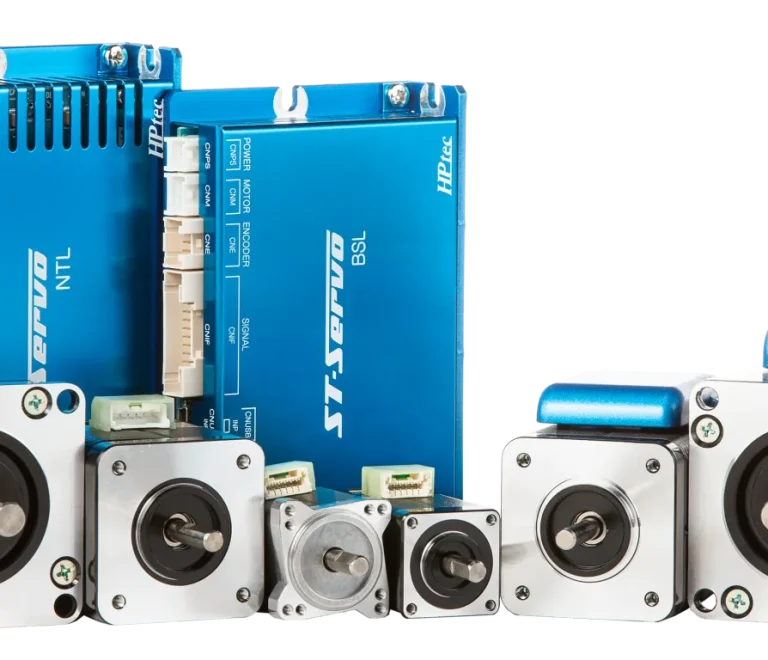
There are three types. The BSL series driver provides pulse control and A/B/Z encoder signal output, suited to architectures that keep an existing host controller sending pulses; the NTL series driver uses RS-485 with Modbus ASCII/RTU communication, has 64 built-in step programs and +LM, -LM, ORG sensor inputs, and is suited to multi-axis daisy-chaining and independent in-axis motion; the CMB series integrates the driver and motor into one unit, eliminating wiring between them and saving control cabinet space. BSL and NTL are drivers and must be used with compatible motors in 25mm, 28mm, 42mm or 56mm frame sizes.
An open-loop stepper has no encoder, so it cannot know its actual position or tell when step loss occurs; as a result, torque output is usually set to only about 60% of the limit to leave a margin. The ST-Servo continuously compares the encoder count with the step count and outputs current magnitude and phase according to the actual position, allowing 100% full torque output (up to 150% in position/speed modes) without step loss. In addition, some "closed-loop steppers" on the market have an encoder to know their position, but still drive at a fixed current and can only correct after step loss occurs; the ST-Servo adjusts current in real time according to the load, achieving both low heat generation and full output.
Closed-loop steppers offer good torque performance and positioning stability at low speeds, lower cost and a simpler structure, suiting low-to-medium-speed positioning, pressing and tension control. For continuous high-speed operation, high-inertia loads or high dynamic response, servo systems remain the main choice. The ST-Servo offers four control modes, position, speed, torque and force, that can be switched instantly, and can switch between open-loop and closed-loop during operation to reduce tuning time, so it can replace small servos in many applications that previously required them.
BSL and NTL are drivers that must be used with the original manufacturer compatible motors (frame sizes 25mm, 28mm, 42mm, 56mm); they are not general-purpose drivers, so you cannot keep the existing motor and just swap the driver; the driver and motor are replaced together. If control cabinet space or wiring is the main concern, the CMB series integrates the driver and motor into one unit, eliminating the wiring between them. On the mechanical side, compare whether the frame size, shaft diameter and flange holes match the original motor; if not, an adapter plate is needed. For evaluation, please provide the model and mounting dimensions of your current motor, and we will help confirm whether it can be replaced.
It depends on how the host controller sends commands. If your existing architecture has the controller sending pulses, choose the BSL series, which offers pulse control and A/B/Z encoder signal output, plus 1 analog input and 32-step programs. If you want to control it with communication commands, or daisy-chain multiple axes for centralized management, choose the NTL series, which offers RS-485 and Modbus ASCII/RTU, 64-step programs, and 8 digital inputs (including +LM, -LM and ORG sensor inputs) and 8 digital outputs. Where space is limited or you want to reduce wiring, choose the CMB integrated type, which also uses RS-485 and Modbus. BSL and NTL support DC24V and DC48V input; CMB is DC24V.