
ST-Servo Servo Stepper Motor
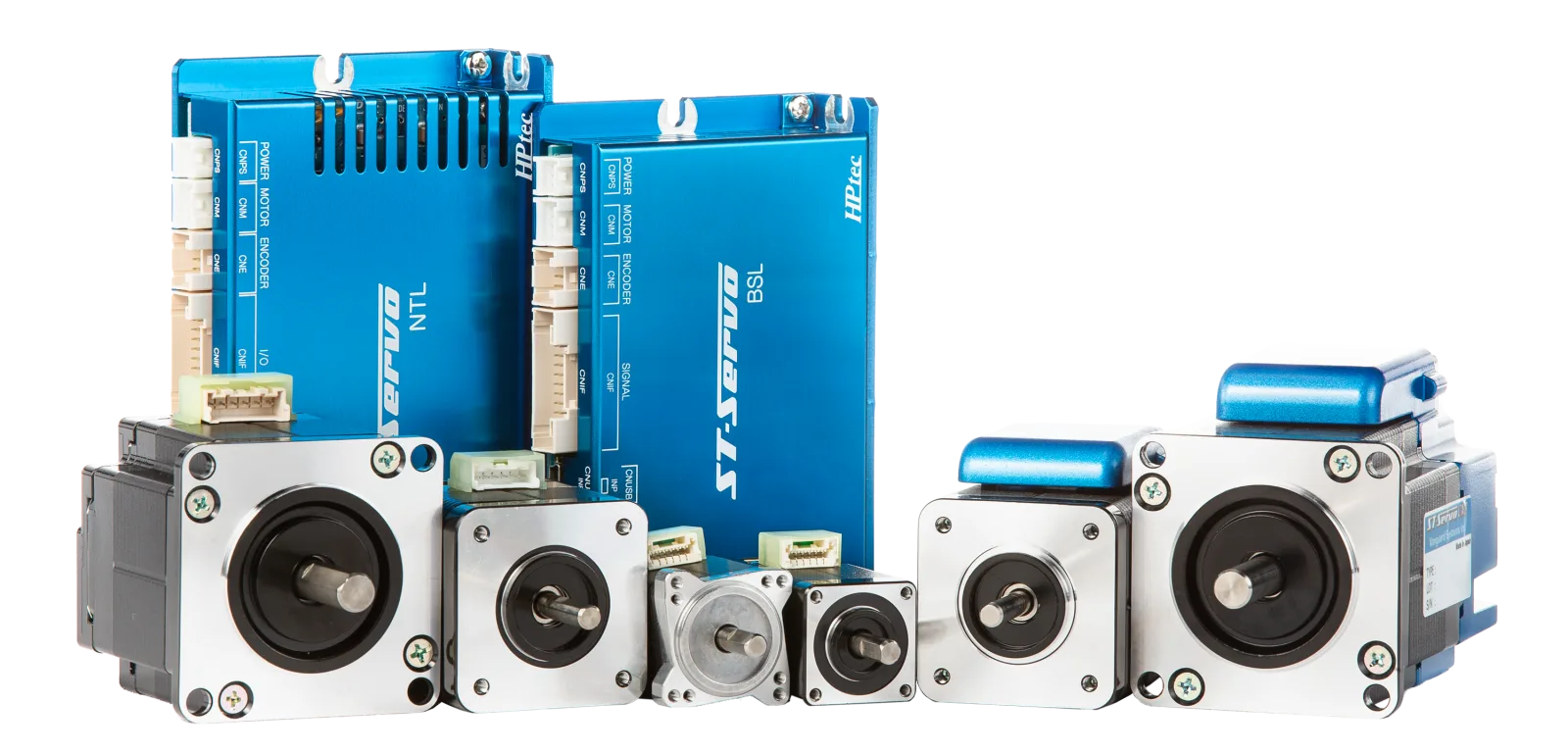
The ST-Servo servo stepper motor (also known as a closed-loop stepper motor) is a stepping system with closed-loop control via a high-performance encoder. It offers four control modes (position, speed, torque and force) that can be switched instantly, and delivers 100% of its torque without step loss. Current is adjusted in real time to the load, resulting in very low heat, low vibration and low noise. Three types are available: the BSL driver, the NTL driver and the CMB integrated motor.
Manufacturer: Vanguard Systems | Category: Stepping Control | Models: BSL series (driver), NTL series (driver)
Servo Closed-Loop Control System
A stepper system with high-performance encoder closed-loop control.
Built from components offering ultra-low heat, high energy efficiency, low vibration, compact size and high output.
Excellent performance in position control, speed control, torque control, force control, high torque at low speed and rotational stability.

Ultra-Low Heat ‧ High Energy Efficiency
Low Noise
4 Control Modes
Flexible Program Control
Low Power Consumption
Full Performance
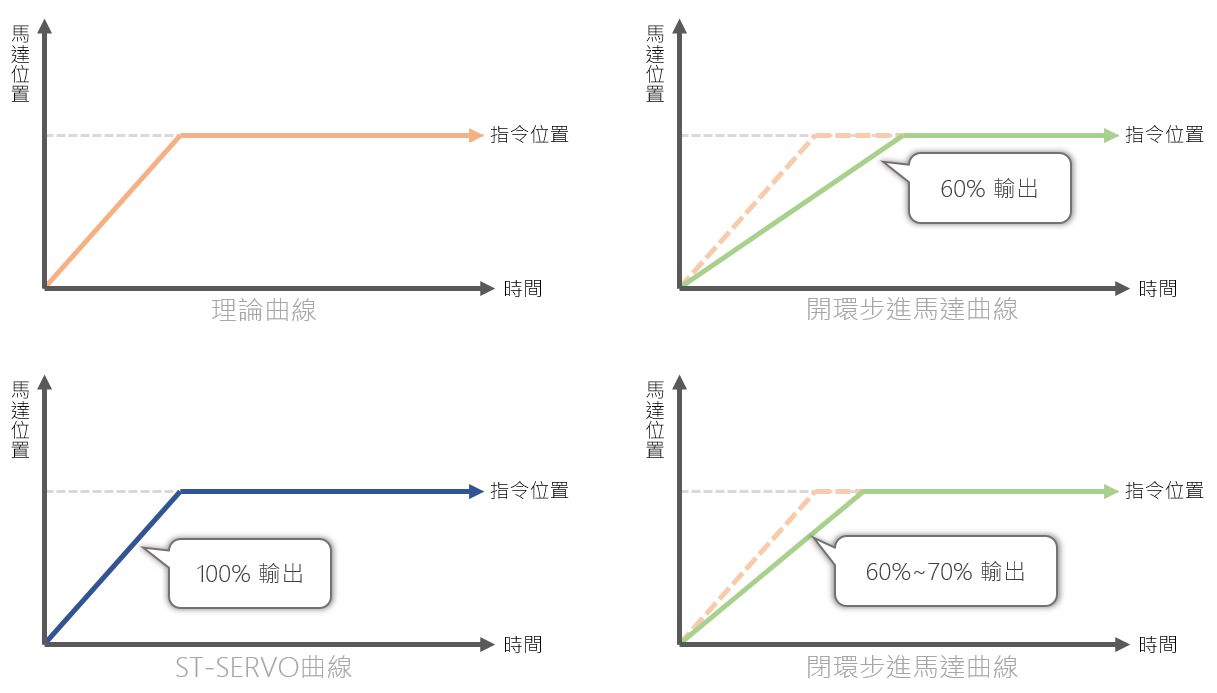
ST-SERVO compares the encoder count with the step count and outputs current of the corresponding magnitude and phase based on the actual position. With this high-performance control technology, torque output can be set directly to 100% (150% for position/speed) without step loss.
Conventional open-loop stepper motors have no encoder, so they cannot know the motor position or when step loss occurs; torque output is therefore usually set to only around 60% of the limit to prevent step loss.
Closed-loop stepper motors know the motor position thanks to the encoder, but still drive the motor with a fixed current and cannot adjust torque output to the load at any moment. Although the encoder can detect step loss so the motor can be restarted and the position corrected, they still cannot achieve 100% full-output control.
Torque Control
Ultra-Quiet
Ultra-Low Vibration
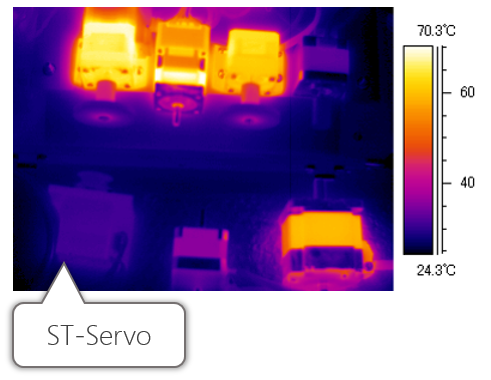
Low Heat Generation
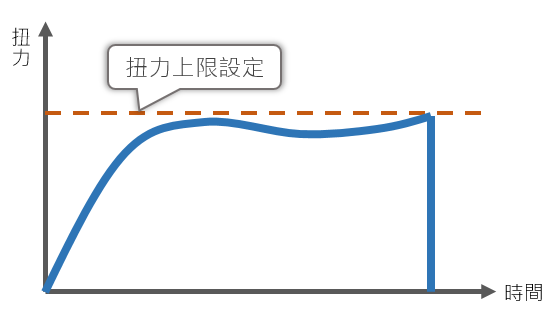
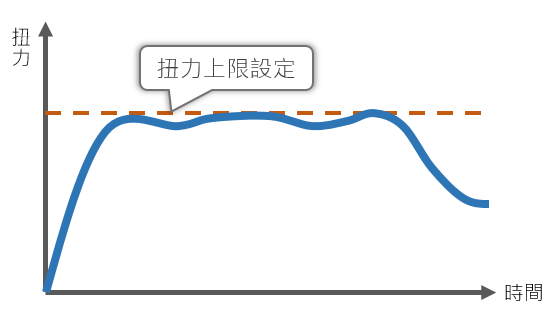
A “target torque” can be set for the driven object; as soon as the torque reaches the target value during operation, the motor stops immediately.
*Motor heat was tested with a thermal imager after 2 hours of operation. ST-SERVO clearly runs cooler than other motor brands on the market.
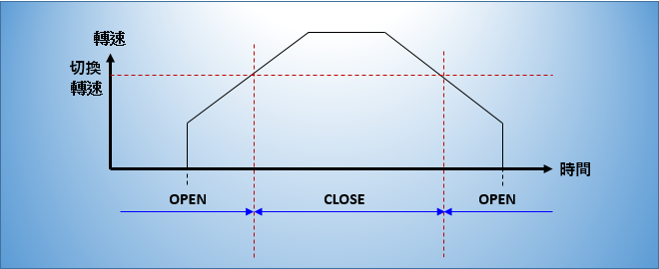
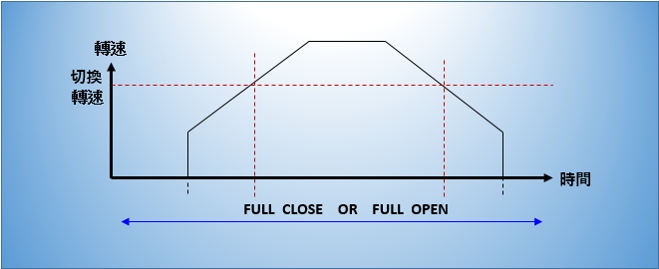
Switching Between Open and Closed Loop During Operation
Electric Gripper Demonstration
Torque Control (Tension Control Demonstration)
Models and Specifications
| Item | BSL series (driver) | NTL series (driver) |
|---|---|---|
| Input voltage | DC24V ±10%, DC48V ±10% | |
| Control modes | Position, speed, torque, force | |
| Rated output current | 2.0A peak | |
| Max. output current | 3.0A peak | |
| Compatible motors | Dedicated motors (25mm, 28mm, 42mm, 56mm) | |
| Input interface (digital signals) | 6 | 8 |
| Input interface (analog signals) | 1 | None |
| Input interface (sensors) | None | +LM, -LM, ORG |
| Output interface (digital signals) | 4 | 8 |
| Output interface (encoder signals) | A, B, Z | None |
| Output interface (brake) | Yes | |
| Monitor interface (analog signals) | M1, M2, SG | |
| Pulse control | Yes | No |
| Built-in programs | 32 steps | 64 steps |
| Communication interface | USB 2.0 (Virtual COM Port) | USB 2.0 (Virtual COM Port), RS-485 (RJ-45 Receptacle) |
| Communication protocol | ASCII | Modbus ASCII / RTU |
| Display | Power LED / Alarm LED / Servo Ready / In Position | |
| Dimensions (mm) | 117 (W) × 73 (D) × 23 (H) | 127 (W) × 78.5 (D) × 23.5 (H) |
| Weight | 150g | 170g |
| Operating temperature and humidity | 0~50°C, below 85%RH (non-condensing) | |
| Storage temperature and humidity | -20~85°C, below 85%RH (non-condensing) | |
Highlighted rows differ between models; values shared by all models are merged into one cell.
BSL and NTL are drivers and must be used with a compatible motor.
For full specifications and dimensional drawings, see ST-Servo Closed-Loop Stepping System Catalog (PDF).
CMB series (integrated driver and motor)
| Item | CMB42C100A | CMB42C101A | CMB56C100A |
|---|---|---|---|
| Input voltage | DC24V ±10% | ||
| Control modes | Position, speed, torque, force | ||
| Rated output current | 2.0A peak | ||
| Max. output current | 3.0A peak | ||
| Input interface (digital signals) | 5 | ||
| Input interface (sensors) | +LM, -LM, ORG (shared with digital signal inputs) | ||
| Output interface (digital signals) | 3 | ||
| Output interface (brake) | Yes | ||
| Built-in programs | 64 steps | ||
| Communication interface | RS-485 | ||
| Communication protocol | Modbus ASCII / RTU | ||
| Dimensions (mm) | 42 (W) × 72 (D) × 54 (H) | 42 (W) × 83 (D) × 54 (H) | 56 (W) × 84.5 (D) × 69 (H) |
| Weight | 350g | 450g | 700g |
Typical Applications
Positioning axes that need full torque output
Encoder-based closed-loop control allows 100% torque output without step loss (up to 150% in position and speed modes), raising usable torque without switching to a servo system.
Gripping with torque control instead of sensors
Torque mode can set a specified torque or a torque limit, using torque detection to sense the object size and apply a suitable gripping force. The manufacturer has demonstrated control fine enough to hold a cover glass without breaking it, with no additional sensor.
Winding and tension control
Tension control can be achieved with a single ST-Servo motor on one side, suiting processes such as film and wire that must maintain constant tension.
Medical and low-noise equipment
Current is controlled in real time according to the load, so heat, vibration and noise are all lower than with conventional stepper motors. Suitable for medical applications and noise-sensitive environments.
Frequently Asked Questions
How is closed-loop control on the ST-Servo different from a conventional open-loop stepper motor?
An open-loop stepper has no encoder, so it cannot know its actual position or tell when step loss occurs; as a result, torque output is usually set to only about 60% of the limit to leave a margin. The ST-Servo continuously compares the encoder count with the step count and outputs current magnitude and phase according to the actual position, allowing 100% full torque output (up to 150% in position and speed modes) without step loss. Some closed-loop steppers on the market have an encoder to know their position, but still drive at a fixed current and can only correct after step loss occurs; the ST-Servo adjusts current in real time according to the load, achieving both low heat generation and full output.
How do I choose between the ST-Servo BSL, NTL and CMB series?
BSL and NTL are drivers that must be paired with compatible motors (25mm, 28mm, 42mm, 56mm); CMB is an integrated driver and motor. BSL offers pulse control, 32 built-in program steps, USB 2.0 (Virtual COM Port) communication with the ASCII protocol, 6 digital inputs plus 1 analog input, and measures 117 × 73 × 23mm, 150g. NTL has no pulse control but increases built-in programs to 64 steps, adds RS-485 (RJ-45 Receptacle) communication with Modbus ASCII/RTU support, 8 digital inputs and 8 digital outputs, and measures 127 × 78.5 × 23.5mm, 170g. The CMB integrated type comes in three models, CMB42C100A, CMB42C101A and CMB56C100A, weighing 350~700g, with RS-485/Modbus ASCII/RTU communication.
When should each of the four ST-Servo control modes be used?
The four modes, position, speed, torque and force, can be switched instantly during operation. Position and speed are used for general positioning and conveying. Torque mode can be set to a "specified torque", stopping immediately once the specified value is reached during motion, or to a "torque limit", reaching at most the limit without exceeding it; this suits motions that require force management such as tightening and press-fitting, and can also be used for tension control. Force mode is used where continuous force must be applied. In addition, open-loop and closed-loop control can be switched during operation, using the different characteristics of each to reduce tuning time, or the motor can run fully open-loop or fully closed-loop.
How does the ST-Servo perform in terms of heat, noise and energy consumption?
It controls the optimal current in real time according to the load, increasing or decreasing current output immediately when external force occurs to reduce energy loss without affecting performance. In testing with a thermal imager after 2 hours of operation, heat generation was noticeably lower than that of other brands of motors on the market. Noise is among the lowest in the industry, making it suitable for medical applications and environments that require quiet operation; vibration is also lower than that of conventional stepper motors. All of the above comparison tests were conducted with the ST-Servo and a conventional stepper motor mounted on a Pitch 2mm slide.
More from Vanguard Systems
- PRO-CHK Torque Meter — The PRO-CHK digital torque meter is used for torque calibration and checking of electric screwdrivers and automatic screw tightening machines. Measuring range is 20–5000 mN·m (0.204–51.02 kgf·cm) with ±0.5% accuracy. It offers four measuring modes (PP / PD / CT / TR) and pass/fail judgment against upper and lower limits, stores 800 readings and outputs data in ASCII format.
- PRO-FUSE Electric Precision Screw Tightening Machine — PRO-FUSE is a closed-loop, stepper-motor-driven electric precision screwdriver for S0.6~M3.0 screws, with a target torque setting range of 10.0~700.0 mN·m. It offers three operating modes (normal, self-tapping and high speed) and 16 tightening programs. Thread-finding detection, torque-rise detection and allowable-turn control in both forward and reverse directions allow precise management of floating screws and stripped threads.