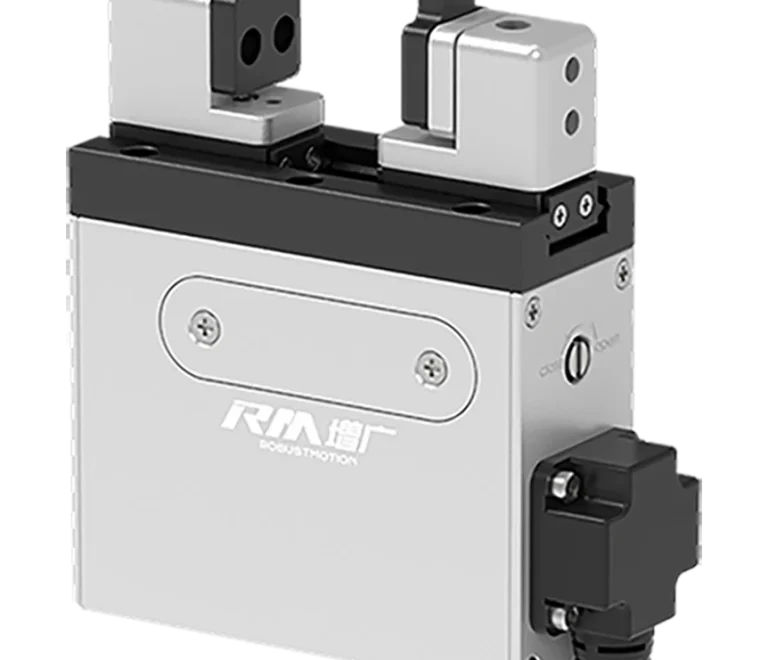
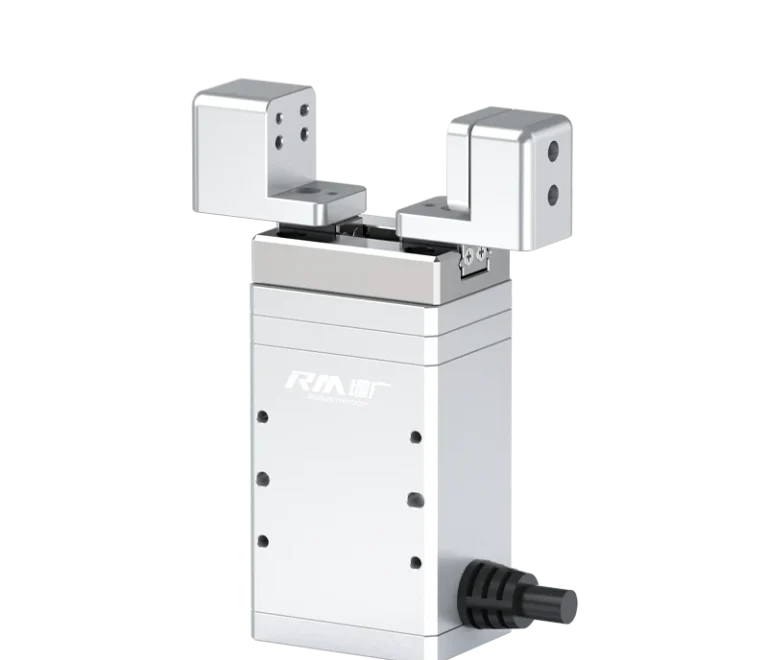
RM-MGBD-HF Precision Force-Control Micro Electric Gripper

RM-RGM Servo Rotary Electric Gripper
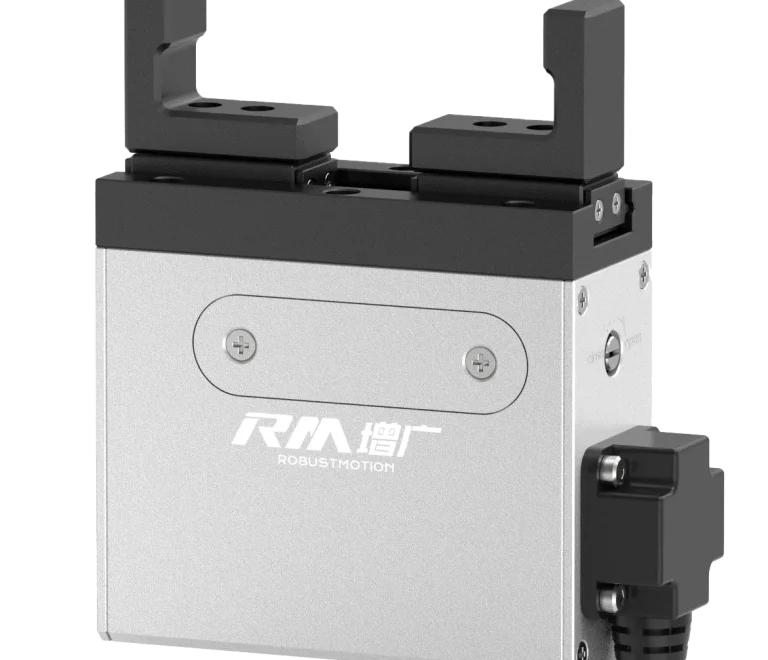
RM-GB Servo Electric Gripper
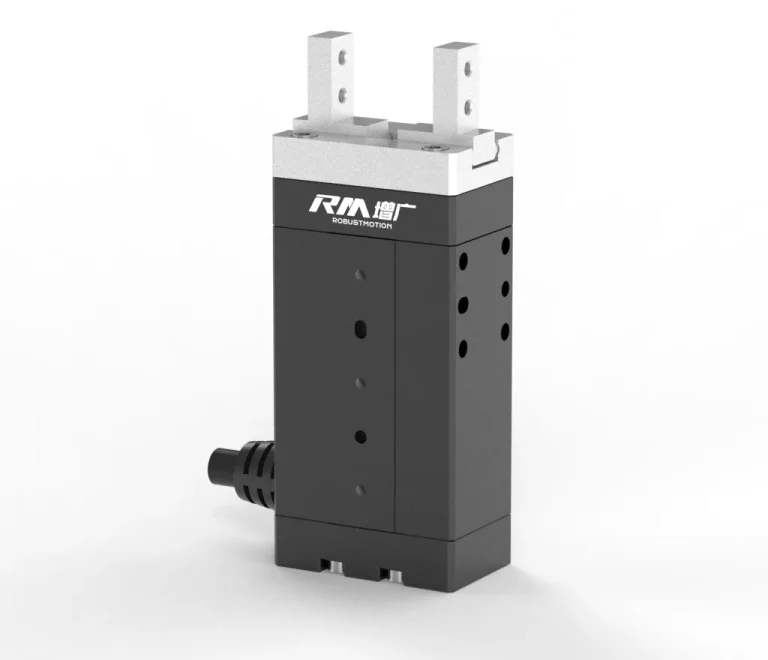

The main use of an electric gripper is to replace a pneumatic gripper of the same size. The difference goes beyond eliminating air lines and solenoid valves: a pneumatic gripper's gripping force is determined by air pressure, and it opens and closes fully with no intermediate state. An electric gripper lets you set gripping force and position in steps, and can detect empty grips and workpiece drops, turning the pick-and-place motion itself into an inspection step.
Selection starts from workpiece size and weight. Stroke determines the range of sizes that can be gripped (6mm to 170mm on this site); gripping force must account for workpiece weight, acceleration and fragility (the minimum 4N setting of RM-RGM can handle fragile parts such as cover glass, while RM-GB reaches up to 700N); repeatability affects alignment in subsequent assembly and is generally ±0.02~±0.05mm. If a station needs to pick, place and rotate at the same time, RM-RGM integrates 360° infinite rotation into the same actuator, eliminating a separate rotation mechanism.
For fragile, high-value parts such as packaged chips, optical lenses and flexible flat cables, choose the SoftForce® precision force-control series: the RM-MGBD-HF miniature two-finger gripper (13mm stroke, 0.02~15N closed-loop gripping force) and the RM-GB-HF/F servo electric gripper (20~60mm stroke, 0.2~98.9N closed-loop gripping force). Both have a built-in force sensor for closed-loop force control, feed back gripping force in real time, and record force-position-time curves for quality traceability.
For control interfaces, ITG integrated models have the controller built in and operate when triggered by I/O combinations, going online about one minute after power-up. Separate controller models pair with RM-C/RM-CEP/RM-CEM/RM-CEU-55 controllers, support fieldbuses such as EtherCAT, PROFINET, EtherNet/IP and CC-LINK, and are suited to centralized multi-axis management. The RM-GB 16 series with strokes of 80mm and above is available only as a separate controller type, with no ITG version. The precision force-control series pairs with dedicated force-control controllers (RM-CEUF/RM-CEMF/RM-CEPF/RM-CEMSF).
| Product | Manufacturer | Category | Stroke (mm) | Gripping force (N) | Repeatability (mm) | Control interface | Models |
|---|---|---|---|---|---|---|---|
| RM-EGB Compact Electric Gripper | RobustMotion | Electric Grippers | 6 ~ 10 mm | 10 ~ 80 N | ±0.02 mm | Modbus RTU | 3 |
| RM-GB Servo Electric Gripper | RobustMotion | Electric Grippers | 20 ~ 170 mm | 65 ~ 700 N | ±0.05 / ±0.02 mm | Modbus RTU / CANopen | 11 |
| RM-GB-HF/F Precision Force-Control Servo Electric Gripper | RobustMotion | Electric Grippers | 20 ~ 60 mm | 0.2 ~ 98.9 N | ±0.05 mm | EtherCAT, PROFINET, CC-LINK, Modbus TCP / RTU, I/O (via external force-control controller) | 3 |
| RM-MGBD-HF Precision Force-Control Miniature Electric Gripper | RobustMotion | Electric Grippers | 13 mm | 0.02 ~ 15 N | ±0.02 mm | EtherCAT, PROFINET, CC-LINK, Modbus TCP / RTU, I/O (via external force-control controller) | 2 |
| RM-RGM Servo Rotary Electric Gripper | RobustMotion | Electric Grippers | 0 ~ 32 mm | 4 ~ 100 N | ±0.02 mm | Modbus RTU | 3 |
| Item | Pneumatic gripper | Electric gripper |
|---|---|---|
| Gripping force adjustment | Air pressure is changed with a regulator; all grippers on the same air circuit change together | Force can be set individually for each motion, switched by program or I/O combination |
| Positioning | Only two end points, fully open and fully closed; intermediate positions require stoppers | Any position within the stroke; intermediate positions can be specified directly |
| Workpiece detection | Reed switches or sensors must be added to know whether a part was gripped | Built-in empty-grip and workpiece-drop detection, with status fed back as output signals |
| Supporting equipment | Air compressor, piping, solenoid valves, filter-regulator unit | DC24V power supply and signal cables; no air lines needed |
| Energy consumption | The compressor runs continuously, and leaks in the piping waste energy constantly | Consumes power only when moving; no air consumed while holding |
| Maintenance | Aging air hoses and leaking fittings, draining filter bowls, refilling lubricators | No air circuit; mainly cable inspection and lubrication of sliding parts |
| Cleanliness | Exhaust may carry oil mist and particles | No exhaust; suited to cleanrooms and food and medical environments |
| Changeover adjustment | Mechanical stoppers and air pressure must be readjusted and test grips performed | Change parameters or switch I/O combinations; multiple settings can be stored |
| Initial cost | Lower unit price, but compressed air and sensor equipment must be factored in | Higher unit price; savings come from air-circuit equipment and ongoing energy use |
Electric is not always better than pneumatic: for simple open/close motions with fixed workpiece specs on a line that already has a stable air supply, a pneumatic gripper is still a reasonable choice. The benefits of electric grippers become clear when multiple workpieces share a line, force must be controlled in steps, or you want the pick-and-place motion to double as an inspection.
Electric grippers are also called servo grippers, electric parallel grippers or e-grippers. By motion type they fall into parallel (two-finger) grippers, rotary grippers and combined types with integrated rotation; all products on this site are parallel grippers, and RM-RGM additionally integrates 360° infinite rotation.
Typical applications include pick-and-place of small parts in 3C electronics and semiconductors, assembly of lithium batteries and cells, handling of medical testing consumables and test tubes, pick-and-place of optical components and glass substrates, and loading and unloading of automotive parts. Besides being mounted as an end effector on SCARA robots, 6-axis robot arms and collaborative robots, they are also common on Cartesian mechanisms, loading/unloading machines and automatic feeding units for CNC lathes.
When paired with a robot, the simplest approach is to wire the gripper's I/O directly to the digital I/O points of the robot controller, letting the robot program control opening and gripping; when real-time readback of position and gripping status is needed, or multiple grippers are managed at once, integrate through the controller via fieldbuses such as EtherCAT, PROFINET, EtherNet/IP and CC-LINK.
The three models are positioned differently. The RM-EGB is the compact type, with a 6~10mm stroke and 10~80N gripping force; it emphasizes small size and "plug-and-play" operation, with force and position selected directly by I/O combinations and no parameter setup, making it suitable for directly replacing small pneumatic grippers. The RM-GB is the main model, with a 20~170mm stroke and a maximum gripping force of up to 700N, and the widest model selection, suiting larger or heavier workpieces. The RM-RGM integrates 360° unlimited rotation in addition to gripping, with an adjustable stroke of 0~32mm, gripping force of 4~100N and maximum rotation speed of 2160°/s, suiting stations that need to pick and rotate at the same time and eliminating a separate rotary mechanism. In short: choose the RM-EGB for small and fast, the RM-GB for high force and long stroke, and the RM-RGM to grip and rotate at once. In addition, the SoftForce® precision force-control series uses force sensors for closed-loop force control and suits fragile, high-value workpieces: the RM-MGBD-HF is a miniature two-finger gripper with a 13mm stroke and closed-loop gripping force of 0.02~15N; the RM-GB-HF/F is based on the RM-GB platform with a 20~60mm stroke and closed-loop gripping force of 0.2~98.9N; both can record force-position-time curves.
For equivalent specifications it can be a direct replacement: the mounting interface is designed to match pneumatic gripper specifications, so the mechanism usually does not need to be redesigned. What changes in practice is the control side: where you previously connected the air line and solenoid valve, you now connect a DC24V power supply and I/O signal lines. Taking the RM-EGB as an example, opening, positioning and gripping at different force levels can be selected through the ON/OFF combination of 3 input signals, and wiring, power-up and operation can be completed in about one minute.
Our electric grippers have built-in empty-grip and workpiece-drop detection, reporting status through 3 output signals, including in motion, open position reached, open position reached with a workpiece detected in outward gripping, grip position reached but no workpiece detected (empty grip or dropped part), grip position reached with a workpiece detected, positioning move not completed but force has reached 100%, and device error. In other words, the pick-and-place motion itself becomes an inspection step, with no additional sensors required.
Yes; the key is that gripping force can be set in steps. The RM-RGM goes as low as 4N and the lowest step of the RM-EGB is 10N, so for thin glass workpieces we recommend evaluating the RM-RGM first. If you need a gripping force below 1N with real-time feedback, for example for packaged chips or micro optical lenses, choose the precision force-control RM-MGBD-HF (minimum 0.02N) or RM-GB-HF/F (minimum 0.2N). With adaptive gripping, the gripping force will not exceed the set value due to small variations in workpiece size. Gripping force values are measured reference values at 25°C with a tolerance of ±15%, so we recommend confirming the usable force with trial grips on the actual workpiece. When selecting a model, feel free to send us the workpiece material, dimensions and weight for evaluation.
The unit price of an electric gripper is indeed higher, but the comparison should include the supporting equipment. On the pneumatic side, you need a share of the air compressor cost, air lines and solenoid valves, and a regulator/filter unit, and detecting whether a workpiece has been gripped requires adding reed switches or sensors; on the electric side, you only need a DC24V power supply and signal lines, with detection built in. In operation, the air compressor runs continuously and any leak in the air lines keeps consuming energy, while an electric gripper only draws power when it moves. The real benefits usually appear where multiple workpiece types share a line, where force needs to be controlled in steps, or where you want pick-and-place to double as inspection; for simple open/close motions with fixed workpiece specifications and a stable air supply, pneumatic grippers remain a reasonable choice.
Yes. All of our electric grippers can be mounted as end effectors on SCARA robots, six-axis robot arms and collaborative robots, and are also commonly used on Cartesian mechanisms and loading/unloading machines. The simplest setup is to connect the gripper I/O directly to the digital I/O points of the robot controller and control opening and gripping from the robot program, with no additional communication setup. If you need to read back position and gripping status in real time, or manage multiple grippers at once, pair them with an RM-C/RM-CEP/RM-CEM controller and integrate through fieldbuses such as EtherCAT, PROFINET, EtherNet/IP or CC-LINK. Flange mounting holes and gripper fingers usually need to be designed for the specific workpiece, and we can help evaluate this.
Without an air circuit, tasks such as replacing aging air lines, fixing leaking fittings, draining filter bowls and refilling lubricators are no longer needed; routine maintenance focuses on periodic inspection of cables and connectors, lubrication of sliding parts, and checking that the gripper fingers are securely fastened. Actual service life depends on load, stroke and cycle frequency, and reflects normal wear of mechanical parts; when planning stations for high-frequency continuous operation, we recommend providing the cycle time and daily operating hours at the selection stage so we can check the margin against the original manufacturer durability conditions.
Cleanroom environments are actually a strength of electric grippers: with no exhaust, they do not carry oil mist and particles toward the workpiece the way pneumatic grippers do, which is why they are common in pick-and-place stations for semiconductors, optoelectronics, medical diagnostics and food packaging. For environments with heavy dust, cutting fluid or oil mist, first confirm that the protection rating is adequate, and if necessary add a dust cover or change the mounting angle to avoid direct splashing. Please provide the actual environmental conditions, and we will confirm suitability against the original manufacturer specifications before recommending a model.
What we need most for evaluation is workpiece information and motion conditions: workpiece material, outer diameter or gripping surface dimensions, weight, and whether it deforms or breaks easily; the required opening range at the gripping point; cycle time and daily operating hours; mounting position and available space; and the type of host controller (robot controller, PLC or fieldbus type). With this information we can usually narrow it down to one or two candidate models. Pre-installation selection evaluation, mechanism integration advice and post-installation technical support are all provided by Utrun-Tech in Taiwan. For trials and on-site evaluation, please call +886-2-87975610 or email info@utrun.com.