
Servo Electric Cylinders and Servo Presses: Pressing You Can Measure
The key to servo electric cylinders replacing pneumatic cylinders or hydraulic presses is that position and load during pressing can be sampled and recorded in real time. Press-fit depth, press-fit force and press-fit waveform become quality data with configurable upper and lower limits, so defective press-fits are caught on the spot rather than relying on downstream sampling inspection.
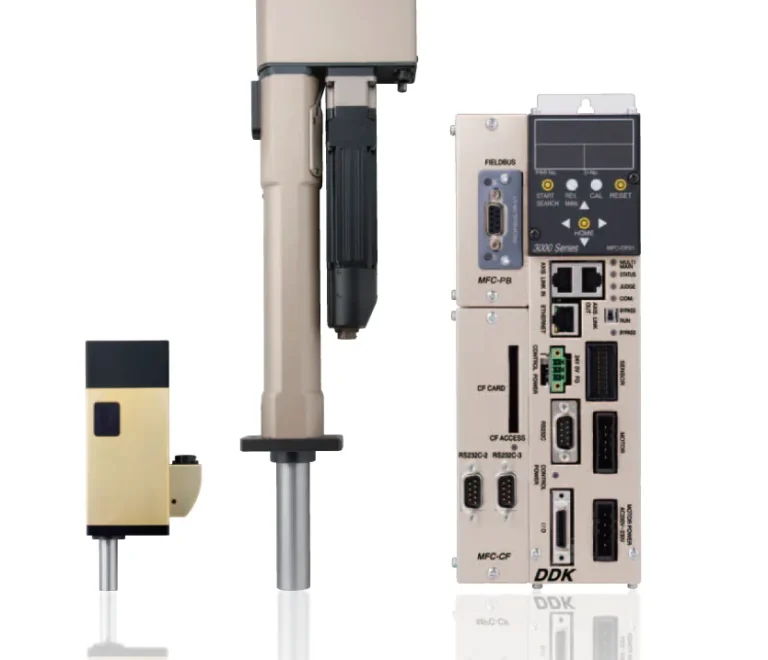
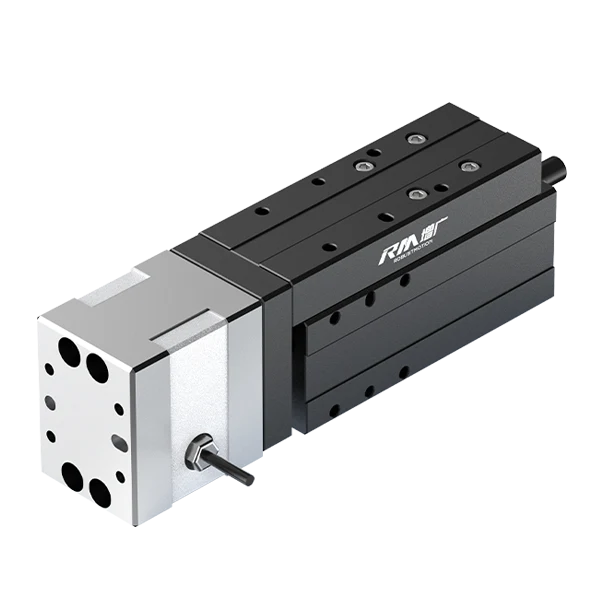
Selection starts by confirming the required thrust and stroke. For small positioning and precision assembly applications, the RM-NPLA miniature slide-table electric cylinder offers 30~210N thrust, 30mm or 50mm stroke and ±0.005mm repeatability. If the process needs to control how much force is applied, such as precision pressing, snap-fit assembly, hot bar bonding and pressure testing, choose the RM-NPLA-HF precision force-control type, which has a built-in force sensor for closed-loop force control, force-control accuracy up to ±0.01N, 0.02~294.9N closed-loop output and 30~150mm stroke. For processes requiring ton-class loads, such as press-fitting, riveting and bearing pressing, use the DAI-ICHI DENTSU (DDK) DSP3000 servo press series, with a standard pressure range of 0.1t~20t and mechanism types including ultra-thin (DPS, suited to multi-axis side-by-side installation), mini (DPM) and upright (DPT) to fit space constraints.
DSP3000 has a built-in load cell with a pressure sampling period within 1 millisecond, ±0.01mm repeatability, and 32 parameter sets per unit or 128 for multiple units. It manages load, distance and waveform data during press-fitting, and offers six press-fit control methods to suit the process, including load control, distance control and load rise/drop point detection.
Servo Electric Cylinders — Selection Table
| Product | Manufacturer | Category | Thrust / load | Stroke (mm) | Repeatability (mm) | Models |
|---|---|---|---|---|---|---|
| DSP3000 Servo Press | DAI-ICHI DENTSU (DDK) | Servo Electric Cylinders | 5~200 (0.51~20.39 ton) / 0.5~1 (0.05~0.1 ton… kN | 100 ~ 400 mm | ±0.01 mm | 3 |
| RM-NPLA Miniature Slide-Table Electric Cylinder | RobustMotion | Servo Electric Cylinders | 210 / 110 / 50 / 30 N | 30 ~ 50 mm | ±0.005 mm | 8 |
| RM-NPLA-HF Precision Force-Control Miniature Slide-Table Electric Cylinder | RobustMotion | Servo Electric Cylinders | 0.02 ~ 294.9 N (closed-loop force control) | 30 ~ 150 mm | ±0.005 (size code 10) / ±0.02 (size code 16) | 18 |
Frequently Asked Questions
What is the difference between a servo electric cylinder/servo press and a pneumatic cylinder or hydraulic press?
Pneumatic cylinders and hydraulic presses cannot know the real-time position and load during pressing, so quality relies on downstream sampling inspection; servo types continuously sample position and load during press-fitting, generating press-fit waveforms and judging them against upper and lower limits, so defective press-fits are caught on the spot. Taking the DSP3000 as an example, the pressure sampling cycle is 1 millisecond or less, repeatability is ±0.01mm, 128 parameter sets can be configured, and load, distance and waveform data during press-fitting can be managed. In addition, the stroke and speed of servo types are programmable, so changeovers only require changing parameters, with no need to readjust mechanical stops.
Which servo electric cylinder series should I choose for the thrust I need?
For small positioning, precision assembly and light-load pressing, use the RM-NPLA miniature slide-table electric cylinder, which provides 30~210N thrust depending on the lead, maximum speed of 50~300mm/s, a 30mm or 50mm stroke and ±0.005mm repeatability. If you need closed-loop control of the thrust itself, for example for precision pressing, snap-fit assembly or pressure testing, choose the RM-NPLA-HF precision force-control type, with force control accuracy of up to ±0.01N, closed-loop output of 0.02~294.9N depending on sensor range, and strokes of 30~150mm. Ton-class processes such as press-fitting, riveting and bearing pressing use the DSP3000 servo press, with a standard force range of 0.1t~20t. The DSP3000 is further divided by mechanism type into the DPS ultra-thin type (suited to multiple axes side by side for a more compact line), the DPM mini type (reduces equipment size) and the DPT vertical type (wide range of performance options), selectable according to space and number of axes.
How long does it take to recover the cost of a servo press?
The payback period depends heavily on your current defect rate and downstream inspection costs, so there is no universal figure. For evaluation, we recommend accounting for three items together: first, the rework and scrap costs of defective press-fits reaching downstream processes, which a servo type can catch at the station; second, the labor hours for changeover and machine adjustment, since a servo type only requires changing parameters without readjusting mechanical stops; third, the data retention needed for quality audits, which may otherwise require additional manual recording. If your products require press-fit quality traceability (such as automotive or medical), data traceability itself is often the main reason for adoption. For an actual evaluation, feel free to send us your process conditions and production volume so we can help with the calculation.