
ETC RNV/RSV Vacuum Reflow Ovens
ETC RNV/RSV vacuum reflow ovens add a vacuum zone after the hot-air convection heating zones, drawing a vacuum while the solder is molten to pull voids (gas bubbles) out of the joints. With low-void paste, void rates can fall below 1%, and component shift and lifting are reduced. The RNV series reaches 280–300°C for standard lead-free paste; the RSV series reaches 350°C for high-temperature solder. The RNV162/RSV162 comes in 4 configurations and the RNV152/RSV152 in 5, handling boards of 330 × 250 mm (WD) or 250 × 330 mm (LE).
Manufacturer: ETC (Eightech Tectron, Japan) | Category: Reflow Ovens | Models: RNV162/RSV162 series, RNV152/RSV152 series
Reflow Ovens That Pull Voids Out of Solder Joints with Vacuum
ETC vacuum reflow ovens are in-line reflow systems from Eightech Tectron of Japan. The RNV/RSV series adds a vacuum zone after the hot-air convection heating zones: the board enters the vacuum zone while the solder is still molten, pressure drops to 1–12 kPa, and the gas bubbles left by evaporating flux are drawn out of the joints before the board returns to atmospheric pressure and moves into the cooling zone.
Large-area joints on power devices, thermal pads and QFNs are the most prone to voids. A conventional reflow oven can only reduce them through paste chemistry and profile tuning; vacuum reflow removes them in the process itself. In the manufacturer’s tests, the same SAC305 paste showed 11.8% voids with nitrogen reflow and 1.9% with vacuum added; with a low-void paste, void rates below 1% were reached.
The RNV series reaches up to 280–300°C for standard lead-free paste, and the RSV series up to 350°C for high-temperature solder. For lines that do not need vacuum, see the NC series convection reflow ovens; for a comparison of all series and the industries they serve, see the ETC reflow oven selection guide.
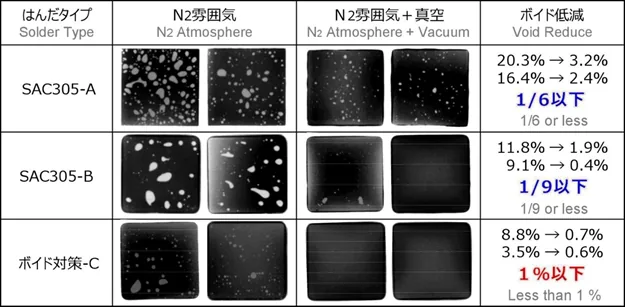
How Far Vacuum Reflow Reduces Voids
The manufacturer compared nitrogen reflow with nitrogen plus vacuum using three solder pastes. X-ray void rates were as follows:
| Solder paste | N2 reflow | N2 + vacuum | Reduction |
|---|---|---|---|
| SAC305-A | 20.3% / 16.4% | 3.2% / 2.4% | 1/6 or less |
| SAC305-B | 11.8% / 9.1% | 1.9% / 0.4% | 1/9 or less |
| Low-void paste | 8.8% / 3.5% | 0.7% / 0.6% | Below 1% |
Vacuum does more than remove voids: solder self-alignment improves, reducing component shift and lifting, and solder fillets become larger, making visual inspection easier. Actual results vary with components, pad design and paste, so we recommend testing with your own product before introduction.
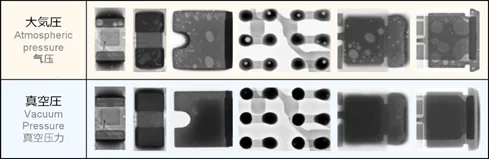
X-ray comparison: atmospheric pressure vs. vacuum
The same components reflowed at atmospheric pressure (top row) and under vacuum (bottom row) show far fewer voids in the joints.
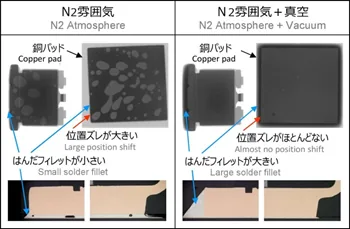
Less shift, larger fillets
With nitrogen only, components shift noticeably and fillets are small; with vacuum added there is almost no shift and the solder fillet grows.
RNV/RSV Vacuum Reflow Oven Design
The RNV and RSV share the same machine: upper and lower hot-air convection heating zones, followed by the vacuum zone and cooling zones, all on a continuous conveyor that connects directly after the printer and placement machine. The only difference is the maximum heating temperature — RNV for standard lead-free paste, RSV for high-temperature solder.
The RNV162/RSV162 comes in 4 configurations with a 1,510 mm wide body; the RNV152/RSV152 comes in 5, including the 613-WD with 3 cooling zones. Both handle boards of 330 × 250 mm or 250 × 330 mm.
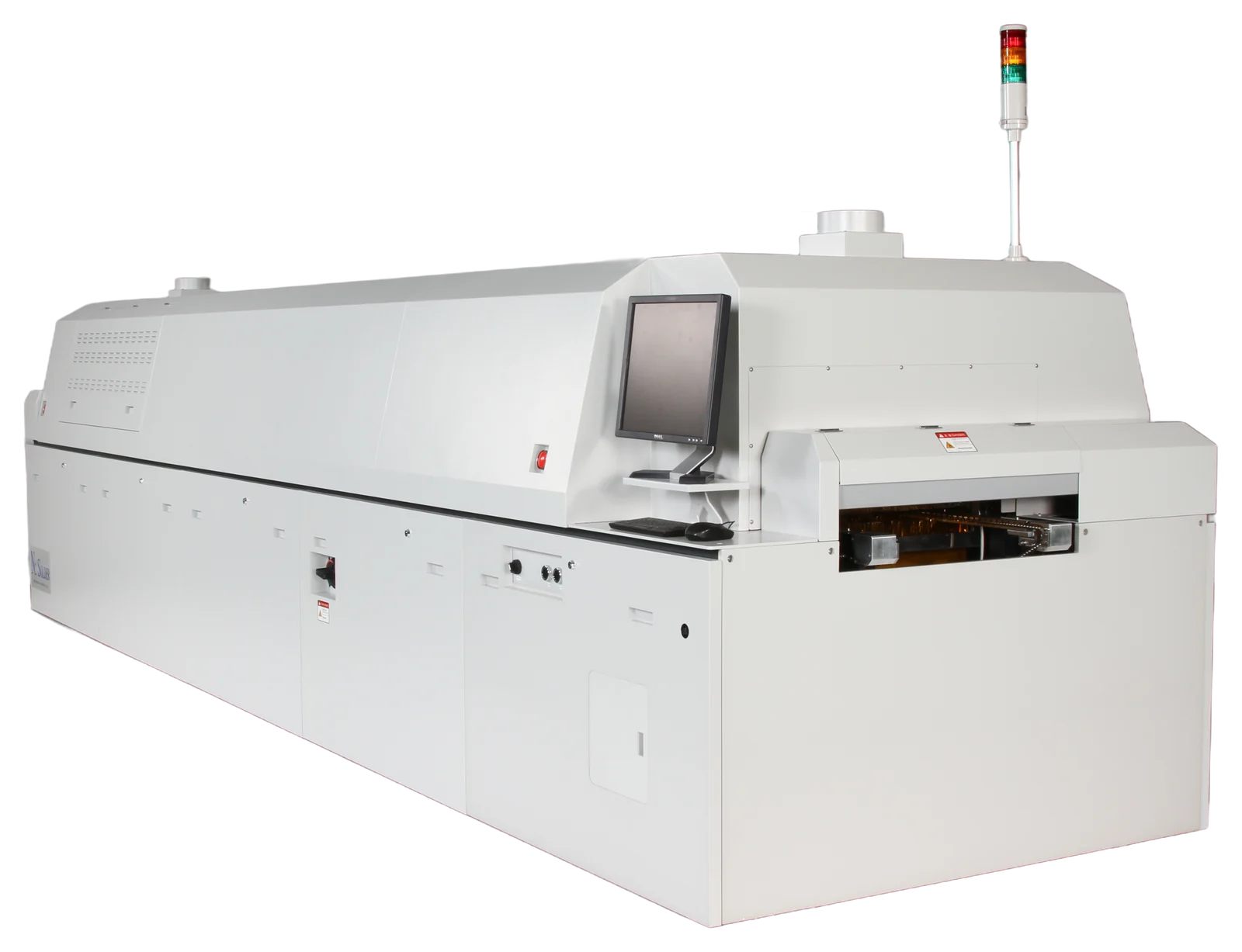
- Upper and lower convection heatingBoth sides are heated by hot-air convection. Compared with hot-plate heating, the temperature difference across the board (Δt) is smaller and heat transfer is better, shortening reflow time; even a small number of zones produces a good profile.
- Double-sided boards in one passOne vacuum reflow pass reduces voids on components on both sides of a double-sided board; metal substrates with aluminum heat sinks on the back can also be soldered.
- In-line continuous productionA continuous conveyor design that connects directly after the placement machine, at up to about one board every 30 seconds.
- Nitrogen or airUsable as a nitrogen reflow oven or in an air atmosphere.
- High insulation, low powerA lighter oven body with low-conductivity insulation, double insulation layers and resin insulation covers; the manufacturer states about 40% power savings, with lower CO₂ emissions.
- Large-capacity flux collectionFlux cleaning is needed only a few times a year, for long maintenance-free operation.
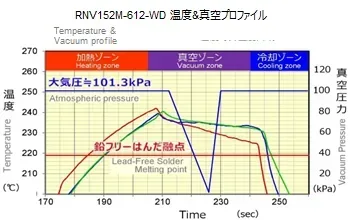
Temperature and vacuum profile
RNV152M-612-WD: once the board passes the lead-free solder melting point it enters the vacuum zone, pressure drops from about 101.3 kPa, and after a short time returns to atmospheric before the cooling zone.
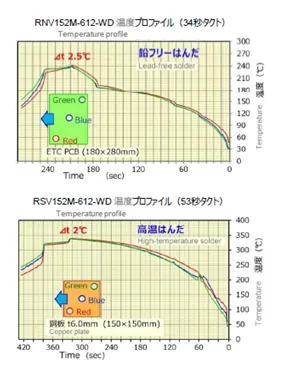
Lead-free and high-temperature profiles
RNV152M-612-WD, lead-free, 180 × 280 mm test board: about one board every 34 s, Δt 2.5°C. RSV152M-612-WD, high-temperature solder, 6 mm copper plate: about one every 53 s, Δt 2°C.
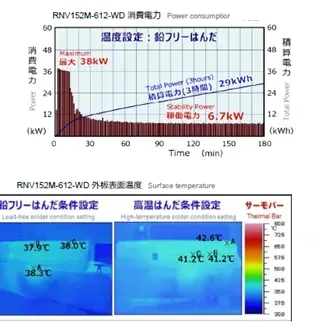
Power consumption and surface temperature
RNV152M-612-WD, lead-free setting: about 38 kW maximum during heat-up, about 6.7 kW steady, about 29 kWh over 3 hours. Outer panel surface about 38°C (lead-free) and 41–43°C (high-temperature).
Models and Specifications
| Item | RNV162/RSV162 series | RNV152/RSV152 series |
|---|---|---|
| Type | Vacuum reflow oven | |
| Models | 4 each of RNV and RSV | 5 each of RNV and RSV |
| Heating / vacuum / cooling zones | 5–6 / 1 / 2 | 5–6 / 1 / 2–3 |
| Max. heating temperature | RNV 280°C; RSV 350°C | RNV 300°C; RSV 350°C (zones 5–6: 400°C) |
| Vacuum (kPa) | RNV 1–12; RSV 1–10 | 1–12 |
| PCB width (mm) | 100–330 (WD) / 100–250 (LE) | |
| PCB length (mm) | 100–250 (WD) / 100–330 (LE) | |
| Power supply | 3-phase 200V | |
| Nitrogen consumption (m³/h) | Approx. 18–24 | |
| Machine length (mm) | 5,151–6,366 | 5,406–6,286 |
| Conveyor height (mm) | 890–920 (standard 900) | |
Highlighted rows differ between models; values shared by all models are merged into one cell.
Full specifications for each series are in the tables below.
RNV162/RSV162 Series Specifications
RNV and RSV share the same machine and differ in maximum heating temperature and vacuum. The three digits in the model number give the number of heating, vacuum and cooling zones; WD and LE differ in the board width and length they handle.
| Item | 512-WD | 612-WD | 512-LE | 612-LE |
|---|---|---|---|---|
| Model (RNV) | RNV162M-512-WD | RNV162M-612-WD | RNV162M-512-LE | RNV162M-612-LE |
| Model (RSV) | RSV162M-512-WD | RSV162M-612-WD | RSV162M-512-LE | RSV162M-612-LE |
| Heating zones | 5 | 6 | 5 | 6 |
| Vacuum zones | 1 | |||
| Cooling zones | 2 | |||
| Max. heating temperature | RNV 280°C; RSV 350°C | |||
| Vacuum (kPa) | RNV 1–12; RSV 1–10 | |||
| Power supply | 3-phase 200V | |||
| Start-up power (kW) | 39.5 | 46.8 | 39.5 | 46.8 |
| Steady power (kW) | 12.5 | 14.7 | 12.5 | 14.7 |
| Nitrogen consumption (m³/h) | Approx. 18–24 | |||
| Dimensions (L × W × H) (mm) | 5,151 × 1,510 × 1,500 | 5,486 × 1,510 × 1,500 | 5,951 × 1,510 × 1,500 | 6,366 × 1,510 × 1,500 |
| Weight (kg) | Approx. 2,900 | Approx. 3,000 | Approx. 3,000 | Approx. 3,100 |
| PCB width (mm) | 100–330 | 100–330 | 100–250 | 100–250 |
| PCB length (mm) | 100–250 | 100–250 | 100–330 | 100–330 |
| Conveyor height (mm) | 890–920 (standard 900) | |||
| Flux collection | Standard | |||
| Fan speed control | 5 levels | |||
RNV152/RSV152 Series Specifications
Heating zones 5 and 6 of the RSV152 reach up to 400°C. The 613-WD has 6 heating zones and 3 cooling zones.
| Item | 512-WD | 512-LE | 612-WD | 612-LE | 613-WD |
|---|---|---|---|---|---|
| Model (RNV) | RNV152M-512-WD | RNV152M-512-LE | RNV152M-612-WD | RNV152M-612-LE | RNV152M-613-WD |
| Model (RSV) | RSV152M-512-WD | RSV152M-512-LE | RSV152M-612-WD | RSV152M-612-LE | RSV152M-613-WD |
| Heating zones | 5 | 5 | 6 | 6 | 6 |
| Vacuum zones | 1 | ||||
| Cooling zones | 2 | 2 | 2 | 2 | 3 |
| Max. heating temperature | RNV 300°C; RSV 350°C (zones 5–6: 400°C) | ||||
| Vacuum (kPa) | 1–12 | ||||
| Power supply | 3-phase 200V | ||||
| Start-up power (kW) | 32.6 | 32.6 | 36.9 | 36.9 | 37.5 |
| Steady power (kW) | 10.9 | 10.9 | 12.3 | 12.3 | 12.5 |
| Nitrogen consumption (m³/h) | Approx. 24 | Approx. 18 | Approx. 24 | Approx. 18 | — |
| Dimensions (L × W × H) (mm) | 5,406 × 1,350 × 1,500 | 5,871 × 1,350 × 1,500 | 5,406 × 1,350 × 1,500 | 6,286 × 1,350 × 1,500 | 5,738 × 1,350 × 1,500 |
| Weight (kg) | Approx. 2,900 | Approx. 3,000 | Approx. 3,000 | Approx. 3,100 | Approx. 3,100 |
| PCB width (mm) | 100–330 | 100–250 | 100–330 | 100–250 | 100–330 |
| PCB length (mm) | 100–250 | 100–330 | 100–250 | 100–330 | 100–250 |
| Component height (mm) | 30 above and below (from chain top) | ||||
| Conveyor height (mm) | 890–920 (standard 900) | ||||
| Flux collection | Standard | ||||
| Fan speed control | 5 levels | ||||
Nitrogen consumption for the 613-WD is not stated in the catalog; please inquire.
Typical Applications
Large-area joints: power devices and thermal pads
On large solder areas such as power transistors, IGBT modules and thermal pads, gas from evaporating flux has difficulty escaping; in the manufacturer's nitrogen reflow tests with three pastes, void rates ranged from 3.5% to 20.3%. The vacuum zone pulls the pressure down to 1–12 kPa while the solder is molten, drawing bubbles out of the joint and improving heat conduction and joint strength.
Bottom-terminated components and double-sided boards
QFN, LGA and other parts with large ground pads underneath cannot be inspected visually after soldering, so voids show up only on X-ray. One vacuum reflow pass reduces voids on both sides of a double-sided board, and metal substrates with aluminum heat sinks on the back can also be soldered.
High-temperature solder processes
For high-melting-point solder choose the RSV series, with a maximum heating temperature of 350°C; zones 5 and 6 of the RSV152 reach 400°C. The same oven can also run lead-free profiles.
Frequently Asked Questions
How does a vacuum reflow oven differ from a standard nitrogen reflow oven?
The hot-air convection heating at the front is the same; the difference is an additional vacuum zone after the heating zones. The board enters it while the solder is still molten, pressure drops from atmospheric (about 101.3 kPa) to 1–12 kPa, and bubbles formed by evaporating flux expand and are pulled out of the solder. The board then returns to atmospheric pressure and solidifies in the cooling zone. Without this stage, voids in large joints can only be reduced through paste formulation and profile tuning.
How low can vacuum reflow bring solder voids?
The manufacturer compared nitrogen reflow with nitrogen plus vacuum using three pastes: SAC305-A fell from 20.3% to 3.2% and from 16.4% to 2.4% (1/6 or less); SAC305-B from 11.8% to 1.9% and from 9.1% to 0.4% (1/9 or less); a low-void paste from 8.8% to 0.7% and from 3.5% to 0.6%, below 1%. Actual results vary with components, pad design and paste, so we recommend testing with your own product before introduction.
How do I choose between the RNV and RSV series?
They share the same machine and differ in maximum heating temperature. The RNV series reaches 280°C (RNV162) or 300°C (RNV152) for standard lead-free paste such as SAC305; the RSV series reaches 350°C, with zones 5 and 6 of the RSV152 reaching 400°C, for high-melting-point solder. The RSV can also run lead-free profiles, so if one line uses both types of solder, the RSV covers both.
What do 512, 612, 613, WD and LE in the model numbers mean?
The three digits are the number of heating, vacuum and cooling zones: 612 means 6 heating, 1 vacuum and 2 cooling zones, and 613 adds a cooling zone. More heating zones make it easier to build a complete profile at higher conveyor speeds. WD and LE differ in board orientation: WD handles boards 100–330 mm wide and 100–250 mm long, LE handles 100–250 mm wide and 100–330 mm long, and the LE machine is longer.
What throughput can a vacuum reflow oven achieve? Is it much slower than standard reflow?
The RNV/RSV are in-line continuous conveyor ovens, not batch ovens, and connect directly after the printer and placement machine. The manufacturer states continuous production at up to about one board every 30 seconds; in measured profiles, the RNV152M-612-WD ran about one board every 34 s under lead-free conditions, and the RSV152M-612-WD about one every 53 s soldering a 6 mm copper plate with high-temperature solder. Actual speed depends on board size, heat capacity and profile.
Is nitrogen required? How much power does it use?
The RNV/RSV can run as a nitrogen reflow oven or in air; nitrogen consumption is about 18–24 m³ per hour. For power, the RNV152M-612-WD on a lead-free setting draws about 38 kW maximum during heat-up and about 6.7 kW once stable, about 29 kWh over 3 hours; its high-insulation body saves about 40% power according to the manufacturer.
What board sizes are supported? Can it handle double-sided boards?
The RNV/RSV series handles boards from 100 × 100 mm up to 330 × 250 mm (WD) or 250 × 330 mm (LE), with component height of 30 mm above and below (RNV152/RSV152). For larger boards, the NC series convection reflow oven handles 50–400 mm wide and 70–500 mm long, but has no vacuum zone. A single vacuum reflow pass reduces voids on both sides of a double-sided board, and metal substrates with aluminum heat sinks on the back can also be soldered.
How often does flux collection and routine maintenance need attention?
The RNV/RSV comes standard with a large-capacity flux collection unit; the manufacturer states cleaning is needed only a few times a year, a long-term maintenance-free design. Actual frequency depends on paste type and production volume.
Other ETC Models
- ETC NC Series Convection Reflow Ovens — The ETC NC series are in-line nitrogen convection reflow ovens without a vacuum zone, for lead-free reflow on general SMT lines. The NC08 comes with 8, 10 or 12 heating zones (NC08M-82/102/123), handles boards 50–400 mm wide and 70–500 mm long at 0.4–1.6 m/min, and uses about half the power of the previous generation — the NC08M-82 runs at about 6.5 kW steady with a measured Δt of 2°C. The NC06 series is also available.
A key-spec comparison of every model, with selection notes and FAQs, is in the ETC selection guide.