
Unitemp RSS Series Benchtop Vacuum Reflow Soldering Systems
Unitemp (Germany) RSS series benchtop vacuum reflow soldering systems for flux-free, low-void soldering. Four models with heated areas from 110 × 110 mm to 310 × 310 mm, up to 400°C (500°C optional), ramp-up up to 180 K/min and vacuum down to 1×10⁻³ hPa; one nitrogen MFC as standard, a built-in formic acid module from RSS-160-SC upward, and a SIMATIC® controller with 7" touch panel storing 50 programs.
Manufacturer: Unitemp | Category: Vacuum Reflow Ovens | Models: RSS-110-S, RSS-160-SC, RSS-210-SC, RSS-310-SC
Benchtop Vacuum Reflow Soldering for Labs and Cleanrooms
The Unitemp (Germany) RSS series are compact benchtop vacuum reflow soldering systems designed for flux-free soldering. A vacuum is pulled while the solder is liquid to draw voids out of the joint, and a formic acid atmosphere reduces surface oxides, so parts can be soldered without flux and need no cleaning — ideal for R&D labs, cleanrooms and small pilot runs.
Four models — RSS-110-S, RSS-160-SC, RSS-210-SC and RSS-310-SC — cover heated areas up to 310 × 310 mm. The aluminum hot plate is heated by heater cartridges or infrared lamps depending on the model; the water-cooled chamber allows ramp-up up to 180 K/min and ramp-down up to 180 K/min (model dependent). Maximum temperature is 400°C, with an optional extension to 500°C.
One nitrogen mass flow controller (MFC, 5 nlm) is standard. From RSS-160-SC upward, a formic acid module with interlock is built in and one more MFC can be added; oxygen, hydrogen and forming gas can also be used depending on the model. Vacuum reaches 1×10⁻³ hPa.
Operation is via a SIMATIC® controller with a 7″ touch panel storing 50 programs of 50 steps each, and process data can be exported over USB or Ethernet. The lid has a viewing window, and a USB camera is available to record the soldering process.
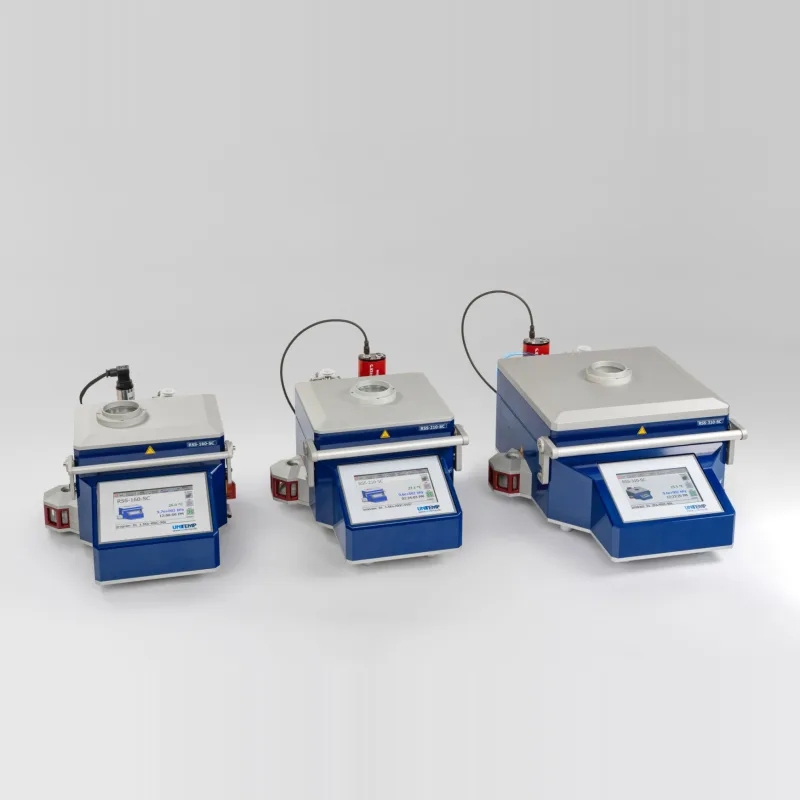
Choose a Model by Substrate Size
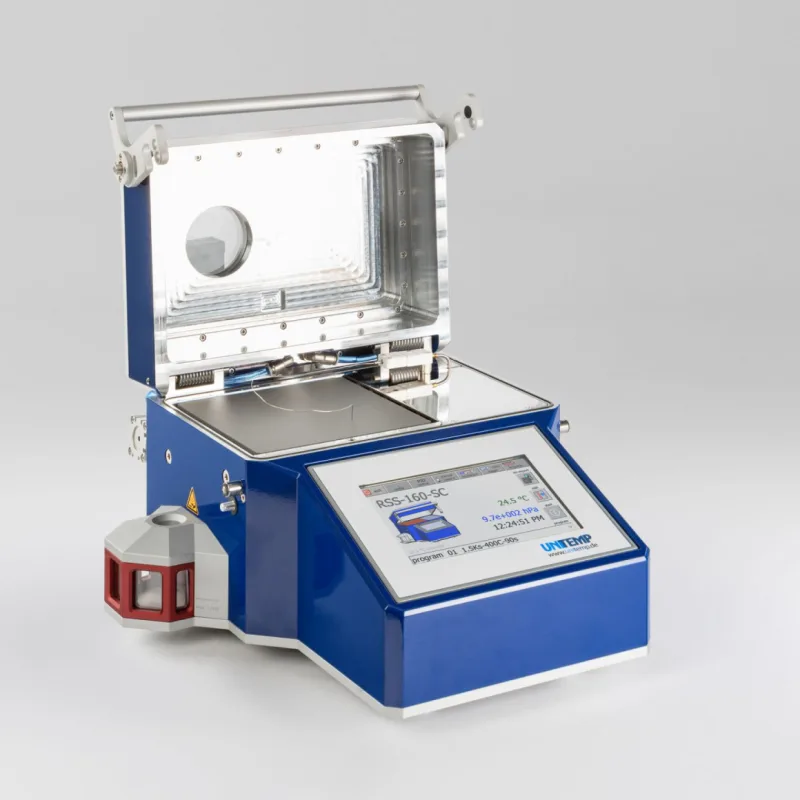
RSS-160-SC
Heated area 160 × 160 mm | Ramp-up 100 K/min
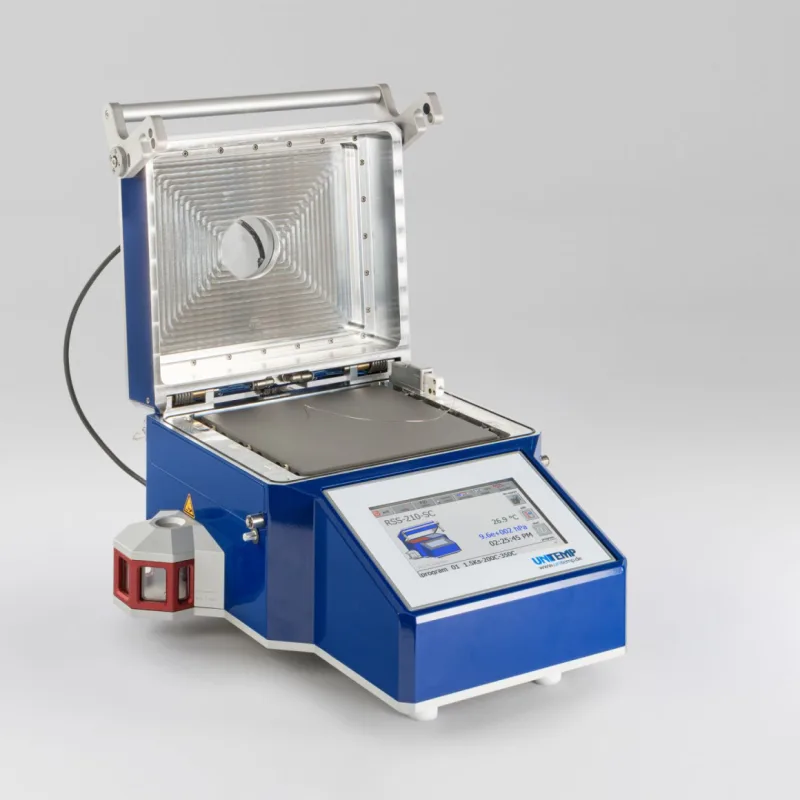
RSS-210-SC
Heated area 210 × 210 mm | Ramp-up 180 K/min
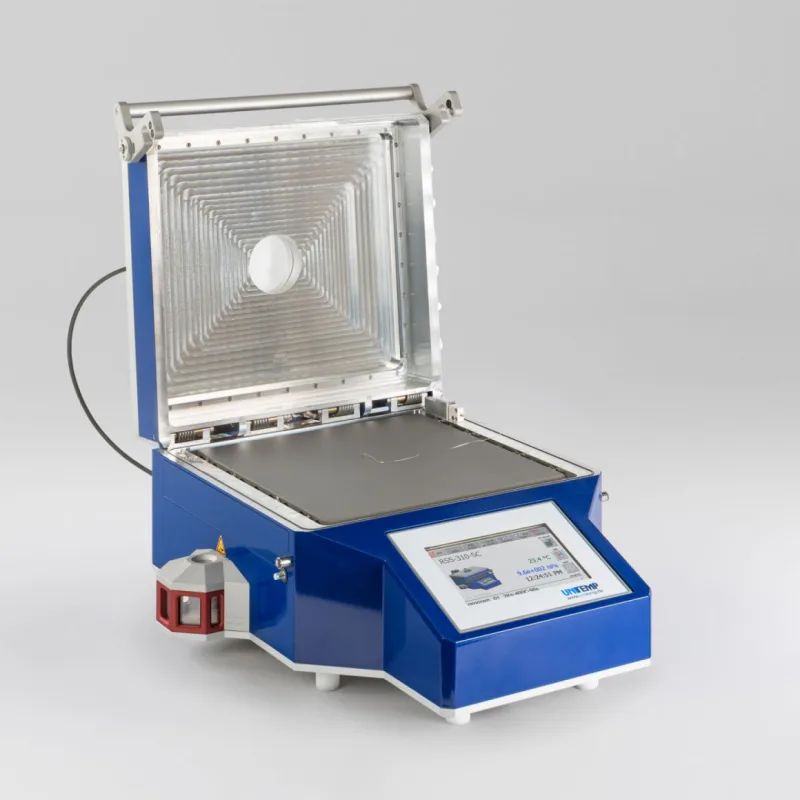
RSS-310-SC
Heated area 310 × 310 mm | Ramp-up 120 K/min
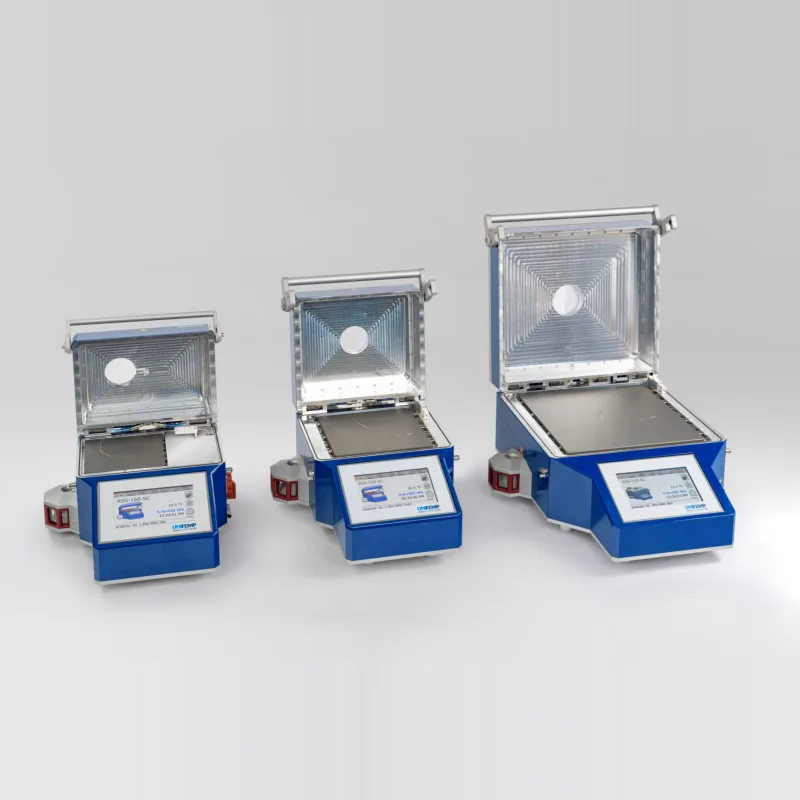
Hinged chamber lid
Chamber height 70 mm (RSS-110-S: 40 mm, 80 mm optional)
Models and Specifications
| Item | RSS-110-S | RSS-160-SC | RSS-210-SC | RSS-310-SC |
|---|---|---|---|---|
| Heated area (mm) | 110 × 110 | 160 × 160 | 210 × 210 | 310 × 310 |
| Chamber height (mm) | 40 (80 optional) | 70 | 70 | 70 |
| Max. temperature | 400°C (500°C optional) | 400°C (500°C on request) | 400°C (500°C on request) | 400°C (500°C on request) |
| Max. ramp-up rate (K/min) | 120 | 100 | 180 | 120 |
| Max. ramp-down rate (K/min) | 180 | 120 | 120 | 90 |
| Vacuum | Optional 3 hPa (VAC I) or 1×10⁻³ hPa (VAC II) | Standard 3 hPa (VAC I); 1×10⁻³ hPa optional (VAC II) | Standard 3 hPa (VAC I); 1×10⁻³ hPa optional (VAC II) | Standard 3 hPa (VAC I); 1×10⁻³ hPa optional (VAC II) |
| Heating and cooling | Aluminum hot plate heated by heater cartridges or IR lamps (depending on model); water-cooled | |||
| Process gas lines | Nitrogen MFC 5 nlm × 1 | Nitrogen MFC 5 nlm × 1; 1 additional MFC optional | Nitrogen MFC 5 nlm × 1; 1 additional MFC optional | Nitrogen MFC 5 nlm × 1; 1 additional MFC optional |
| Formic acid module | Optional (FA I / FA II, on request) | Standard (FA III, shared gas line, with interlock) | Standard (FA III, shared gas line, with interlock) | Standard (FA III, shared gas line, with interlock) |
| Process gases | Inert gases such as nitrogen, oxygen, hydrogen, forming gas, formic acid (depending on model) | |||
| Controller | SIMATIC® 7" touch panel; 50 programs × 50 steps | |||
| Data interface | USB, Ethernet | |||
| Chamber lid | 60 mm viewing window; USB camera optional | |||
| Dimensions (W × D × H) (mm) | 274 × 517 × 215 | 390 × 530 × 280 | 390 × 570 × 280 | 465 × 670 × 280 |
| Weight (kg) | 14 | 25 | 27 | 46 |
| Power supply | 230 V, 1.6 kW (115 V, 1.2 kW) | 230 V, 2.4 kW (115 V, 1.2 kW) | 230 V, 9 kW (115 V, 7 kW) | 230 V 3-phase, 18 kW |
| Cooling water | External water chiller required | External water chiller required (WC-I) | External water chiller required (WC-II) | External water chiller required (WC-II) |
Highlighted rows differ between models; values shared by all models are merged into one cell.
For vacuum pumps, water chillers, formic acid traps, oxygen analyzers, thermocouples, side viewing windows and other options, please contact Utrun-Tech to confirm the configuration.
For full specifications and dimensional drawings, see the Unitemp RSS series page and datasheet.
Typical Applications
Flux-free, low-void soldering
Vacuum during the liquid phase draws voids out of the joint, and formic acid reduction removes oxides, so parts can be soldered without flux and need no cleaning — for power devices, ICs and BGA soldering and quality checks.
Flip-chip, bumping and package sealing
Flip-chip processes, solder bump reflow, PGA chip soldering, package sealing, adhesive bonding and heat treatment of semiconductor wafers.
Lab process development and prototyping
The benchtop unit fits in a lab or cleanroom; 50 programs and USB/Ethernet data logging make it easy to compare profiles and atmospheres for new processes and prototypes.
Frequently Asked Questions
How do I choose between the four RSS models?
Mainly by substrate size. RSS-110-S has a 110 × 110 mm heated area and a 40 mm chamber (80 mm optional), and is the smallest unit at 14 kg. RSS-160-SC, RSS-210-SC and RSS-310-SC have 160, 210 and 310 mm square heated areas with a 70 mm chamber, and include the formic acid module and interlock as standard. RSS-210-SC has the fastest ramp-up (180 K/min). RSS-310-SC needs a 3-phase 230 V supply; the others are single-phase.
How does vacuum reflow differ from nitrogen reflow?
In ordinary reflow, flux and volatiles in the paste leave voids in the joint that hurt heat transfer and reliability. Vacuum reflow pulls a vacuum while the solder is liquid, drawing the voids out. The RSS series reaches 1×10⁻³ hPa, and with formic acid reducing the oxides, parts can be soldered without flux and need no cleaning — ideal for power devices and die attach that require low void rates.
What do I need to use formic acid?
RSS-160-SC and above come with the FA III formic acid module (shared with the nitrogen line, with interlock); FA I / FA II are available on request for RSS-110-S. Unitemp recommends a chemically resistant vacuum pump and a formic acid trap (single or double) in front of the pump. Utrun-Tech can help confirm the configuration for your process.
Is external cooling water required?
Yes. The hot plate and chamber of the RSS series are water-cooled and need an external supply; Unitemp recommends a closed-loop water chiller — WC-I for RSS-160-SC, WC-II for RSS-210-SC and RSS-310-SC. Switch boxes are available so the pump and chiller start and stop with the unit.
Other Vacuum Thermal Processing Models
- Unitemp 2Z-HVS Series High Vacuum Sealers — Unitemp (Germany) 2Z-HVS high vacuum sealers for hermetic MEMS sealing and getter activation. Vacuum 10⁻⁶ hPa (pump included), two heating zones in one chamber (top 200°C, bottom 450°C), 20 K/min ramp rates and up to 6 packages per run; 2Z-HVS-100 for parts up to 16 mm in diameter, 2Z-HVS-200 up to 42 mm.
- Unitemp RSO Series Infrared Vacuum Reflow Ovens — Unitemp (Germany) RSO series vacuum reflow ovens with bottom infrared lamp heating: up to 650°C, ramp-up up to 10 K/s and temperature uniformity within 1% of set point. RSO-210 takes 210 × 210 mm substrates or 8" wafers, RSO-300 takes 300 × 300 × 40 mm parts; vacuum 1×10⁻³ hPa (10⁻⁶ hPa range on HV versions), up to 4 MFC gas lines and formic acid flux-free soldering.
- Unitemp VSS Series Vacuum Soldering Systems — Unitemp (Germany) VSS series vacuum soldering systems: VSS-300 for 300 × 300 mm substrates or 300 mm wafers, VSS-620 for large substrates up to 620 × 620 mm. Infrared bottom heating with 3 programmable zones, up to 450°C (600°C optional); vacuum 10⁻³ hPa, 10⁻⁶ hPa on -HV versions; chamber sealed gas-tight from the lamps; inert gas, oxygen, forming gas and formic acid, up to 4 MFC lines.
- Unitemp VSS-300 Vacuum Reflow Oven – Formic Acid Edition — A Utrun-Tech configuration of the Unitemp (Germany) VSS-300 pre-equipped for formic acid reduction soldering: FA II formic acid module (individually controlled gas line) plus FA IV automatic refilling, chemically resistant vacuum pump and isostatic graphite heating plate. Substrates up to 300 × 300 mm, 450°C (600°C optional), 150 K/min ramp-up, 10⁻³ hPa vacuum.
A key-spec comparison of every model, with selection notes and FAQs, is in the Vacuum Thermal Processing selection guide.
More from Unitemp
- Unitemp RTP Series Rapid Thermal Processing Ovens — Unitemp (Germany) RTP series rapid thermal processing (RTP/RTA) ovens with top and bottom infrared lamp heating, for wafers up to 100, 150 or 200 mm. Up to 1000°C (1200°C or 1500°C optional by model), single-wafer ramp-up up to 150 K/s (200 K/s optional), vacuum 1×10⁻³ hPa (10⁻⁶ hPa range on HV versions) and up to 4 MFC gas lines — for annealing, oxidation, nitridation and alloying.
- Unitemp VPO-300 / VPO-300-HV Vacuum Process Oven — Unitemp (Germany) VPO-300 vacuum process oven for single 300 mm (12") wafers or 300 × 300 mm substrates. Cross-aligned infrared lamps top and bottom (18 kW each) with 3 programmable zones, up to 1000°C (1200°C optional), 40 K/s ramp-up; vacuum 1×10⁻³ hPa on VPO-300 and 10⁻⁶ hPa on VPO-300-HV, overpressure up to 0.2 MPa optional, up to 4 MFC gas lines.
- Unitemp WB-300-U Semi-Automatic Wire Bonder — Unitemp (Germany) WB-300-U benchtop semi-automatic wire bonder with three motorized, mouse-controlled axes and 1.0 µm accuracy. Wedge, ball, bump and security ball bonding with a simple tool change, using 17–50 µm gold or aluminum wire; 165 mm deep-access bond head, 62 kHz ultrasonics (0–2 W), 60 mm / 250°C heated stage, motorized wire spool, EFO and a SIMATIC® 7" touch panel.